


American Reformer’s former Editor-in-Chief, Timon Cline, interviewed R. Albert Mohler Jr. on the past, present, and future of American Protestantism and evangelicalism.
Timon Cline: Dr. Mohler, thank you for agreeing to participate in this symposium, and it’s a delight to discuss these topics with you.
R. Albert Mohler Jr.: Timon, I’m very glad to take part in answering these questions and participating in this symposium. I hope what comes out of it is both heat and light.
TC: A big question, maybe the big question at present, is how we define America. Everyone is asking this question, and asserting an answer, in some way. Tocqueville said that the first settlers (especially in New England) defined the nation and that all subsequent questions can, in some sense, be answered by looking back at them. Is that still true? How would you define our beginnings, especially as it relates to our religious and cultural character? What is the role of Protestantism in all this?
AM: There’s a lot to unpack there, but the first thing I want to say is if I ask myself the question, “What is a nation?” I have to say it is a distinctive people with a distinctive territory and a distinctive heritage and a distinctive worldview—a distinctive set of commitments that is the foundation for the establishment of the entire society. And it is a common project to which all are accountable—citizens and rulers, legislators and judges. They are accountable to a specific identity with a specific creedal form. But more than a nation is a specific people speaking a common language and building a common society. And I’ll go back to say, I think any lasting understanding of a nation has to be based upon metaphysical claims that are honestly projected.
I’m not saying that people who speak another language cannot join. I’m not saying that it is a closed system so that no one may join. But I am saying they have to know exactly what they’re joining and they have to be joining it gladly.
The United States of America, and I’ll just use the term “American”, the American experiment, is predicated on a continuation of the project of Western Civilization, particularly as channeled through the Anglosphere. It is a continuation of the Western achievement as represented in English-speaking cultures, and in particular in England, later Great Britain. The United States, certainly by the late colonial period, understood itself to be an intentional continuation of that tradition with particular corrections that they saw as absolutely necessary for the preservation of that same civilizational pattern—which is to say the American experience was not established at the very first in any sense, as an anti-monarchical movement. It was explicitly established as a Republican ideal as an extension of Christendom.
And it’s right to reference the Puritans. And that means that to this was added the dimension of covenant. Thus, the understanding was that this new nation, even before we think of nation in formal political terms, this new nation was the continuation of the civilization of Christendom in a new continent, adapted to new needs. And quite honestly, what became clear is that those who were framing this republic saw it as a correction of that inherited model as well as a continuation of the same. When you look, for instance, at the achievement of the American constitutional order, it’s amazing how closely it follows an English or British model, but with very significant modifications. But the modifications were actually intended by those who made them, in order to perpetuate that tradition through time.
TC: What role does religion, generally speaking, play in nationhood? All the way back to Polybius we can find people saying that it’s the glue of society, maybe the source of all greatness. Is this perennially true? Does there have to be a central, animating cult around which everything else revolves, or are different models workable?
AM: I believe that every nation makes metaphysical claims and even more pervasively is established upon metaphysical principles and assumptions, whether these are acknowledged as theological or not. And that’s another way of saying that they are essentially theological whether those who make them want them to be considered theological or not. We need to understand that at the time of the American founding, there was no such thing as a secularized society. The basis of law, the origin of morality, the authority of government itself was understood to rest upon explicitly Christian foundations. You could back up and say these are religious foundations, but it was clearly a Christian foundation in its shape as an extension of Christendom. And furthermore, it was for the most part pervasively Protestant. And that is the founding worldview of what became the United States of America. And the fact that so much of this was not articulated, is a reflection of the fact that it was so widely assumed and unquestioned. Those who founded this nation and framed its Constitution and laws did not see such an acknowledgment as necessary.
It is very interesting that this issue emerges by the time you get to the midpoint of the 19th century, and we see a clear reset in the arguments made by President Abraham Lincoln going back to the Declaration of Independence, and the fact that there are natural rights endowed by the Creator that are the basis of this moral order and political experiment.
Every nation makes metaphysical claims. For instance, even if you look at the Soviet Union in its early decades, it clearly is making ultimate claims. The ultimate claims are amorphous, but there is the very deadly claim of the collective people. And of course you remember that that was supposed to be a transitional period where there was a dictatorship necessary in a tight regime until communism could be achieved, which of course it never was. But my point is, if you’re making transcendent claims, even when you think you’re secular, you’re just deifying the state.
Joseph Bottum, years ago, wrote a book on the theological shape of secular ideas. And he points out that the Left has its own set of doctrines that are almost a mirror image of historic Christian doctrine in the structure of Christian theology. And so even when they say they’re not making metaphysical claims, they do claim that certain truths are true before government declares them to be true. They’re confused about what they are, who they come from, and what they mean, but they are inherently religious in their shape.
I believe that the continuation of the American experiment is entirely dependent upon an explicit reference to the Christian and indeed overwhelmingly Protestant nature of our origins. And I believe the abandonment and repudiation of those origins, will lead to the demise of the American nation as we know it. I believe that every nation is based upon some clear metaphysical claims that transcend the state. And so even where you have an avowedly atheistic state, they still have to make some kind of metaphysical claim and they all do, and murderously so.
TC: Joseph Bottum has called the collapse of the Protestant mainline the most significant event in American history of the past 150 years. To your mind, what is it exactly that this collapse entailed? What did it do to the country generally and its soul, we might say, specifically?
AM: Yeah. The very fact that we refer to those historic churches—sometimes referred to as the Seven Sisters of the Protestant Mainline—as mainline is because they were the unquestioned power establishment in the United States. They were clergy to the elites, to the powerful class, to the rulers, to the legislators. They largely either established, or continued leadership in, higher education and the dominant arenas of culture. The collapse of the Mainline is essentially theological surrender and abdication. I think the leaders of mainline Protestantism imbibed and embraced theological liberalism, and eventually destroyed the foundations on which they built their own magnificent edifices. And eventually all of that gave way.
The bottom line is that a secular culture doesn’t need a secular church, and those liberal churches became so thoroughly secularized and captured by the spirit of the age, that they were just the secular choir of an increasingly secular culture.
And let’s remind ourselves that the shift from the one position to the other is not a shift away from explicit Christian identity to some kind of neutrality. Neutrality does not exist. Instead, they became engines for the very revolution that was redefining the entire society. The problem for the mainline church is that the new revolutionaries really didn’t need altars, priests, or choirs, and so they just went immediately to the periphery. This is not a group sent into exile. This is a group that completely burned down their own house. Furthermore, they did it in every way conceivable. They did it ideologically, they did it culturally, they did it financially, but they also did it biologically. They just stopped reproducing.
TC: Most consider the mainline collapse a net loss for America, but is there any sense in which it was a net gain for Protestant Christianity? The modernist-fundamentalist controversy split American Protestantism. This might have been good for orthodoxy, but it produced certain cultural externalities, to be sure.
AM: That’s an incredibly honest question, and it’s what we have to face. I regularly speak of the fact that in terms of the influence in the larger culture, I think we all miss, or at the very least note, the absence of the cultural cohesion and theological authority that came with Mainline Protestantism at its height in functional terms, and those are the only terms that many secular people are even interested in. But even in structural terms, the loss of mainline Protestantism meant that increasingly entire sectors of society were freed from any kind of theological influence or control whatsoever. And it shows up, of course, most clearly in the absolute vulnerability of all these institutions to the sexual revolution and the gender ideologies and all the rest. There are absolutely no defenses. There is no Protestant establishment with the power or moral authority to say no to anything. Instead, the liberal churches just became handmaidens to the progressivist ideologies. So we miss it in the sense that I think we miss the time when the vast majority of Americans knew, and were at least to some degree concerned about, what Christian pastors, priests, leaders, and faithful Christians thought about the matters at hand.
One of the interesting things is to note the distinction during the late years of the Eisenhower administration, President Eisenhower dedicated the headquarters of the National Council of Churches in New York City, he actually articulates kind of a functional understanding of the necessity of this mainline religion, and I’m paraphrasing here, but he basically said it’s just really important that this nation have a God and I don’t care who it is. And by that time, liberal theology had already so infected the mainline churches and they were already so given over to moral and social compromise that honestly by the time they built the building, the moral authority was already leaving the house.
At the same time, all of this is very clarifying. You just have to wonder how anyone can possibly miss the truth. You drive down the street in a major American city and you see hulking old religious buildings that used to be centerpieces of the entire society. This was the heart of the city. Grace Episcopal Cathedral, the First Baptist Church, First Presbyterian Church, the Lutherans, the Methodists, this was the Protestant establishment. Because most of those denominations and churches have gone so horrifyingly liberal, all you have is a gay pride flag out front with nobody inside the building. And that is clarifying, and so clarifying, you would think no one could possibly miss it. And by the way, it evidently is clarifying even to many because you’ll note that the decline in the mainline was the subject of enormous scholarly interest in the second half of the 20th century. There was an entire industry in the analysis of the decline of the Mainline churches. Well, they have since declined to the point that no one appears to be interested in them in academia anymore. And there’s a parable in that reality too.
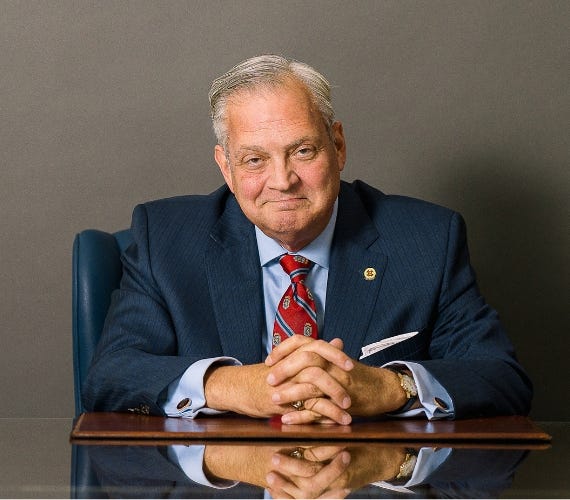
TC: You’re a self-professed Evangelical, a term that is subject to varying definitions. How do you define it? Why are you one? Is it a reactionary label? Is it still useful today? And recall briefly for everyone the genesis of this moniker and group in the American context.
AM: I am an evangelical, but I’m a Christian, I’m a Protestant, and I’m a Baptist before I’m an evangelical. Evangelical is one of those terms that is necessary but insufficient. It’s necessary because one way or the other, there has to be a way of saying this is someone who holds convictions, this is an institution committed to some convictions, this is a church that has convictions that are immediately distinguishable from mainline liberal Protestantism. Evangelical from its origin in modern usage means not liberal. Now of course, it’s more than that. It refers to the gospel, it refers to conversionism, in most cases it refers to conservative doctrine. It really refers in a way—that even the founders of evangelicalism I don’t think fully understood—to a fundamental continuity of believers who confess the faith once for all delivered to the saints. And that’s been a growing understanding.
The evangelical movement in the United States really goes back to the 1920s, ’30s, and ’40s, the period before, during, and immediately after World War II when evangelical became a term used to distinguish a group of conservative Christians from liberalism, first of all, but secondly from separatist fundamentalism. And so the term fundamentalist, which emerged in the 1920s based, of course, upon the title of a series of booklets and what became a term of art. The term fundamentalist generally is associated because of experiences in the North particularly. You could even date most of this to the split that took place in Presbyterianism in the North. The evangelicals were those who really agreed in most respects with the doctrine of the fundamentalists. But they disagreed in terms of withdrawal from the culture and instead wanted a mode of engagement with the culture.
Looking now, you can look at these new evangelicals as they arrived on the scene, and one of the things to note is that—with very rare exceptions–the Left simply saw them as fundamentalists with a new name. It’s also true that some of these early evangelicals overcorrected from fundamentalism in such a way that they became quite squishy in terms of definition. You also have other things such as the evangelical susceptibility to sheer pragmatism and numerical calculations focused on numbers and buildings.
But I’m going to argue that if we dispense with the word evangelical, we have got to come up with something that can replace it. And I think, like so many other terms in our modern vocabulary, it’s very difficult to imagine what that could be. I think, however, the fact that this question is raised, as you raise it, makes it very clear that evangelical is no longer a sufficient definition. You’re going to have to say what kind of evangelical you are, and what exactly you mean by evangelical. So it may be that this is transcended by a new term, but that term is not commonly known at this time.
Evangelicalism became a project unto itself, and some of the founders of that evangelical movement were quite visionary. They were aggressive. I think what is rather surprising to us now, is the confidence with which they seemed to believe they were winning in the culture. And I think that is perhaps something that needs greater correction than the vocabulary. The understanding of our placement in culture is something that the current generation of evangelicals has to see very differently than the founding generation of American evangelicalism.
TC: Evangelicals have always been concentrated in the Bible Belt, in the South, the frontier, etc. Does this fact have any bearing on their cultural status? Ability to capture or build mainstream institutions? Is there a sense in which Evangelical cultural influence has fed off being somewhat marginal compared to the mainline?
AM: There are all kinds of realities that come to play in this. For one thing, you can make the argument that the word evangelical simply means continuity with classical, orthodox Protestantism and classical, orthodox Protestantism gave birth to most of the institutions in the early republic, even in colonial America. So it’s not that evangelicals don’t know how to create institutions, it’s that most of these institutions got quickly co-opted, and I would make the argument that this is tied to the emergence of secular trends in the culture. The German university model is the prevailing academic model, and by the time you get to William F. Buckley Jr., and God and Man at Yale by the time you get to the 1950s, Buckley’s frankly just crying from the steps of the town hall that this is now basically a godless secular experiment.
But the cultural impact of mainstream or Mainline Protestant Christianity continued long after the theological collapse of those churches. As a matter of fact, They convinced themselves that you could save the morality while ditching the theology. And of course, that’s a ridiculous notion. The moral influence continued only for a very short time. The transition from the fifties to the sixties tells us that the moral influence actually can’t long exist once the theological convictions are gone. So there’s a sense in which Protestants were the elites in early America, but once you have a bifurcation of Protestantism both theologically and sociologically, then it turns out that the Protestants on the upper end of the sociological scale quickly abandoned Protestantism. Protestants actually do know how to start things. They have a horrible track record of keeping them.
Furthermore, by the time you have the break in the fundamentalist-modernist controversy, and similar developments took place of course in European nations as well. By the time that happens, the cost of institutionalizing is astoundingly greater. So to make the point, American evangelicals as represented by people like Dr. Carl Henry, who was a dear friend to me, they actually had the vision of establishing a great evangelical research university in the American northeast. They wanted to create a university. One of their models in mind was the University of Chicago or Stanford University there in Palo Alto because both of them were recent in their origins.
These projects have Rockefeller money, Stanford money, and the idea was we could do that. Now the reality is–and I have these documents myself—that by the time they were proposing this vision, it was already beyond—indeed, vastly beyond— evangelical financial power to create any such institution. And honestly, I think what we now know is it was already too late to establish, even on secular terms, a modern research university of that type. Even if a Bill Gates or an Elon Musk decided to create a university, the reality is by the time they look at actually accomplishing that, they give it up. It is just nearly impossible. It is kind of like saying we’re going to build a modern cathedral, a millennium after that would’ve made sense to everyone. You just can’t do it anymore. And I think that’s emblematic of the fact that evangelical Christians left their former denominations with little. Remember in the northern denominations, they exited and they were either kicked out, or they voluntarily left because of the victory of liberalism. They went out with very little in hand. All the economic capital stayed in and was captive to those Mainline Protestant denominations, with rare exceptions.
TC: You remember the Moral Majority and Reagan years. For us millennials, what was it like? These days, the Moral Majority is often described as a failure, but that could not have been apparent then. Was it, to your mind, a failure? What lessons can be learned from it for present and future coalitions?
AM: I’m an Augustinian in terms of my theological commitments. So I assume failure over a long span of human history is inevitable in some sense. I believe it is just as Augustine said, it’s incumbent upon us to seek to preserve order, to preserve the goods, to perpetuate order, and to perpetuate those goods in The City of Man as long as possible. But this really robs us of the temptation to triumphalism. It also robs us of any temptation to quietism or withdrawal.
I lived through all of this period and I knew the principals involved. I knew Jerry Falwell as a dear friend. Francis Schaeffer was a mentor to me, especially through his writings. I was really forged as an adolescent in the context of early efforts toward something that would be like the moral majority, and particularly in the pro-life movement. And I want to say to those who quickly dismiss and are embarrassed by the moral majority, if you weren’t in some sense engaged on these issues then in terms that would identify you with the Moral Majority, or with the New Christian Right, then frankly I think you were useless in terms of the larger culture. I learned also something as a very young man, and that is: if you’re afraid of someone calling you a part of the New Christian Right, or the Christian Right or whatever, then you’re just useless.
Jerry Falwell and I are different. First of all, in time and in age, but we’re different in theological profile. I’m a confessional Protestant. He really began as a genuine fundamentalist, though I think shifted in that. But he shifted mostly in terms of the cultural engagement. I will simply say, to know Jerry Falwell was to know a figure who loomed large on the national scene and for good reason. And by the way, to know him was to know he had incredible skills, incredible gifts, and he was basically happy in his disposition. In other words, part of the reason why a lot of the leaders of the New Christian Right were effective is because they were actually happy in their disposition, passionate in their love of God and country, and sincere in their calling of Christians to respond to a moral emergency, and to translate that into political action. They knew that because we live in a political culture, we have a political responsibility.
So sure, they were unsophisticated as judged by the political sophisticates. But you know what? They did raise up an army. And by the way, that army had babies and those babies had babies. And when you look on the campus of the institution I lead, or you look in the churches I know, there are an awful lot of the grandchildren of the people who were willing to stand in a line outside an abortion clinic and contend for righteousness through groups like the Moral Majority. Of course, there were clumsy and embarrassing moments. In politics that’s going to happen. Further, the more populist the movement is, the more embarrassed it can be by some, frankly marginal statements or flamboyant controversies or for that matter, moral failures.
But by and large, I would just tell you that I spoke at national meetings for the Eagle Forum with Phyllis Schlafly. I spoke at events on the campus of Regent University for Pat Robertson. I spoke at Liberty and worked for Jerry Falwell, and I’ll tell you, I would do it all over again. And a lot of the snarky young evangelicals who think that all of that was uncool looking at their polyester suits and big ties, I just want to say you’re only here because those guys were willing to put their ministries, and their reputations at risk for the cause of truth.
We do know more now, and we really can’t be triumphalist in the way that many of them were. This is especially in the political realignment that came with the election of Ronald Reagan in 1980. An enormous number of the leaders of the religious right thought, “we will be able to take it all. We’re going to be able to legislate, we’re going to have our folks in the governors’ mansions in the Senate, the House and the White House.” And it didn’t turn out that way as an Augustinian would understand. But I am not going to apologize for the effort, nor am I going to gainsay the achievements that movement accomplished.
TC: A related question but looking inward to evangelical institutions. The Conservative Resurgence, especially in Southern Baptist institutions: I think people forget how big of a hard-won turnaround this was. What was the situation in the 1970s and early 80s that precipitated this reaction? Are there analogs today? Do evangelical institutions need a similar turnaround? If so, do you see conservative leadership up to the task?
AM: There’s a lot to unpack there. First of all, the Conservative Resurgence in the Southern Baptist Convention turns out to be an unpredictable and unlikely occurrence. Looking across denominational history and the fate of Christianity in the modern world, the recovery of any denomination of the size of the Southern Baptist Convention is incredibly rare. A part of the reason for that is that Southern Baptists were established and concentrated in a part of the country that was far more intact than what you would find on the coast in the Northeast. And so Southern Baptists were largely insulated from a lot of the issues that had already torn apart other denominations.
Now, they were also asleep at the wheel in just understanding the way progressive takeover happens. The progressives took over the institutions of the Southern Baptist Convention in the 1920s and 30s, and they did so because they could talk one way and act another way. They could talk the language of grassroots Southern Baptists, but in their offices and in their institutions, they were transforming the SBC in the image of Mainline Protestantism. Now, it’s not to say that the leaders in the SBC at that time were anywhere near the liberals you would find in northern denominations. It is to say that they weren’t anti-liberal. And that turns out to have been fatal because the fact that they weren’t anti-liberal meant that progressivism really became the order of the day. One of the problems in the SBC was that the culture of revivalism had created a common vocabulary that people could use, and they could mask how far left they were moving and how fast they were moving in a Leftist direction. It took a long time for grassroots Southern Baptists to just wake up.
I’m going to make a statement here, and the older I get, the more I’m certain of this. We’ve talked about a couple of things so far. You asked about the Moral Majority, and the New Christian Right, et cetera. Now you ask about the Conservative Resurgence in the SBC. The fact that those happen parallel in time, is not a coincidence. It’s not an accident. When I talk about this, I often want to say that because of revivalism, and because of decades of theological imprecision, Southern Baptists were vulnerable to slick and dishonest theological arguments. Every time they’d try to pin a liberal professor to the wall, the liberal professor used sweet Jesus language in order to completely bamboozle conservatives into thinking there’s no problem here. And that continued for a very long time. Conservatives had an opportunity in 1964, conservatives had an opportunity in 1968, but it didn’t get anywhere. It was only in 1979 that the first true movement conservative president was elected in the SBC. And what changed was the emergence of issues such as abortion.
So I said the two questions are now linked in sociological terms, maybe even in epistemological terms. Abortion was understood in categorical terms, in a way that some theological doctrines–lamentably–were not. One of the ways the Conservative Resurgence in the SBC began to gain steam is because people figured out, I know your theology because you support the right of a woman to destroy a baby in her womb. And then all this stuff comes together. Of course, you have the sexual revolution as well, but that is always delayed in the heartland of the SBC just because of sociology. Now of course, it shows up in the college campuses, it shows up in the larger culture and the next thing you know, it’s everywhere. But it was slower in the SBC. It took a while for Southern Baptists to wake up to how pervasive it had become, however.
The Conservative Resurgence achieved a great deal. For one thing, it produced the opposite of the pattern in the Mainline denominations in the North. It was the liberals who left, and when the liberals left, and they went out and did even more liberal things, and they became a cartoon of themselves day by day. Now there are fewer and fewer of them because, predictably, they’re not having babies. In that is a picture of mainline liberal collapse concentrated in even a brief period of time. And to be honest, I hardly ever even ask about them anymore.
However, the recovery in the Southern Baptist Convention was an opportunity, not an achievement. I believe the only lasting form of Protestantism is confessional Protestantism in its classic form. And that has to come with a comprehensive Protestant worldview. And all the commitments have to be seen as unified, and all of them have to be considered as necessary. And I get to see a generation that understands those commitments fully and embraces them. But when you look across the entire area of Southern Baptist dominance, I mean, quite honestly, you can’t say that that’s a widespread set of commitments even among a lot of people who believe themselves to be Christians and go to church.
When it comes to what is broadly called evangelicalism and its challenges, I do not think that there will be any turnaround in evangelicalism, and I certainly don’t believe the current leadership is up to that task. I believe there has to be a clear separation between those who are leaving or have left evangelicalism. We need to stop identifying them as evangelicals. We need to correct the vocabulary. We need to take them off our lists. We need a list that puts Mainline liberal Protestants over here and evangelicals over here and the people who are moving out of evangelicalism we just need to go ahead and put their name on the other list. We also need to protect the word evangelical as best as we possibly can for conservative Protestants, who are holding comprehensively to that tradition, to our confessions, our creeds, and with the moral truths that are inseparable. And that also means, honestly, a political engagement that is made necessary.
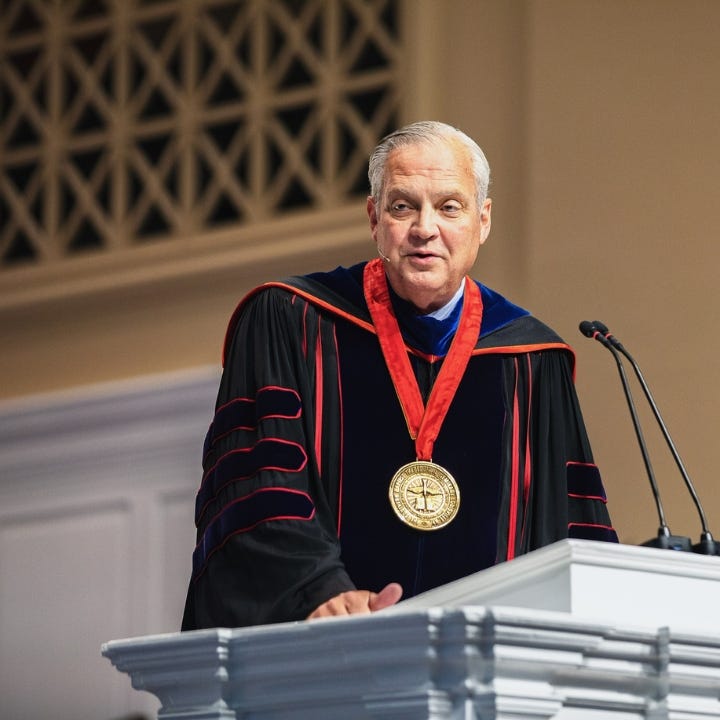
TC: For some time, it has seemed like Evangelicals crave outside, “mainstream” acceptance or approval. Rather than directing the culture, it tries to fit itself into it. Self-described Evangelicals might, for example, write for the New York Times, but most of their energy is spent on criticizing Evangelicals whereas a Catholic writing for the same publication generally presents a confident apology for Catholicism to the general public. How can this posture be altered on the Evangelical front?
AM: Well, I don’t know how evangelicals can handle the decisions made by the New York Times, but we do know the New York Times wants to count among its roster of opinion writers those who identify as conservative and evangelical. But I see this as the David Brooks quandary I refer to often. That is, that we now know what the New York Times thinks an evangelical ought to be. And what those evangelicals ought to do is criticize evangelicals for being evangelicals. And so if you are at least under the pattern that the mainstream media has set, the gatekeepers of the establishment have set, if you claim to be evangelical, but have basically nothing to do with evangelical Christianity on the ground, then you’re our writer.
I don’t think evangelicals can do anything about that except keep telling the truth about that reality. At the same time, we recognize that even a legacy newspaper like the New York Times still has enormous influence in society. So we just have to understand where that is. And frankly, we need to counter engage, and at least at times, contribute as best we can, just to articulate clearly what evangelical Christianity actually is.
Which, by the way, you would think that even the New York Times, just to take one newspaper would figure out. It’s as if they’ve never asked “If the people we have are supposedly evangelicals and we’re going to make that claim with a straight face, how can they be continually outliers in terms of evangelical voting patterns, ways of life and everything else?” It’s not like they don’t know what they’re doing.
The closer you get to academia, the closer you get to the arenas where social status is granted and social capital is gained. Evangelicals, and I’ll simply say, middle-class Americans, lust after it. Evangelicals will crawl on their knuckles to get it. Evangelicals will claim they’re doing it for Jesus’ sake. And honestly, it’s a very difficult virus to resist, because there are so many goods to be bestowed by liberal elite culture. The problem is that the only way to get it is to abandon the faith once for all delivered to the saints, and to turn on the evangelical movement as something of a modern prophet.
And to be honest, the media plays that game with Catholics as well. When it comes to an issue of the LGBTQ Revolution, they’re going to go to James Martin, who is basically an apologist for that movement, even contrary to the doctrine and catechism of the Roman Catholic Church. But it is true that conservative Catholics are much better at showing up as conservative Catholics, Catholic Catholics when they’re given those opportunities. Shame on evangelicals for not having the same commitment, but I don’t think the people we’re talking about are acting unpredictably. I think it’s quite predictable. I think the people who play that game, we already know are playing that game. It’s a game we just have to refuse to play.
TC: For years we’ve been told that religion, specifically Christianity, is in decline. First, are we a post-Christian society? Second, recent data evinces a potential correction among younger generations: young men are more religious and more conservative. Does this change the narrative? Cause for hope? What do evangelical institutions need to do to capitalize off these new trends?
R. Albert Mohler Jr.: Evangelicalism has been horrifyingly thin in terms of its culture, and I think that’s because it has at times been horrifyingly thin in terms of its doctrine, theological understanding, and biblical worldview. So we have to resist thin and work for thick. And I think that’s where you find very interesting health, vitality and potential among conservative evangelicals. I think that’s why, honestly, we can look at an army of young men who want to be young men for Christ. They want to be clear in their Christian identity, they want to be married, they want to be fathers. They want to fulfill a Christian man’s responsibility in the world. And I will say that the emergence of so many of these incredibly committed young men are actually astounding, and it is probably the most encouraging development I’ve seen in my adult lifetime.
It is also true that there are millions of young Christian women who are committed to live for Christ and to be wives and mothers, and with their husbands to raise their children in the nurture and admonition of the Lord, to help build society, and uphold righteousness. But it is the emergence and visibility of convictional young men that is the game changer. And as I have remarked recently, analytical studies are now demonstrating that for the first time, so far as we know in the history of the Christian church, when you look at Generation Z, more young men are attending church on a regular basis than young women. That can’t be insignificant. And honestly, I think we’re the people who are supposed to have a biblical theology that indicates why it is so absolutely necessary that convictional, courageous, masculine young men emerge into the full set of responsibilities that falls to a Christian man. And without that, there can be no recovery. That alone is not a recovery, but that is, I think, one of the first and most important fundamental prerequisites for a recovery. And so that makes me very, very happy. It has come in some ways more quickly than I had expected, but it also reminds us we have a long battle ahead in a warfare to which we’re called.
TC: It seems to me that a lot of Evangelicals are unsettled by the young men. Maybe they’re too zealous, or maybe they’re too radical, and so on. Following on the last question, how should Evangelical leaders and institutions receive the young radicals who, to be sure, have much cause to be rather radical, given the world they’ve grown up in?
AM: I have been very influenced in my understanding of these things by the Russian sociologist Pitirim Sorokin. I don’t buy his entire understanding of cultural dynamics, but I really do think he understood in a classic Russian sense, the fact that every single civilization faces first the challenge of reproduction. And secondly, the challenge of channeling male energy into productive manhood, including the roles of father, husband, and citizen. Pitirim Sorokin and others made the observation that there isn’t a single civilization in human history that’s really had a struggle with assisting young women to move into responsible female roles, especially in marriage and in the home. That’s happened organically in almost every civilization. But at the same time, almost every civilization from ancient Sparta to the United States of America faces the challenge of channeling the energies of young men into productive manhood.
This development will scare people. It might scare the average evangelical mom to know what goes on when a pack of 12-year-old boys are playing in the yard. On the other hand, a father looking at that understands that is the essence of what it means to be a boy, in the presence and company of boys. And this is a stage on the way to manhood in which the father, by the way, is absolutely a determinant if he knows exactly when to lean in, when he needs to, and he understands exactly what he sees and hears when he sees and hears them.
The fact that a lot of people in society are scared by convictional, passionate young men shouldn’t surprise us. Young men are going to do young men things. They’ve always been prone, even when rightly directed, to a zeal not yet tempered adequately by wisdom. And every smart society, even before you get to Christian commitments, every smart society just based upon, I think, natural law, has come to understand that it’s our responsibility to turn all that wonderful energy, and that incredible strength, and that vitality, and that masculine camaraderie, into something that will help build the nation. And for the church, it’s even more important. We understand God’s good pleasure is in young men growing into manhood. And there’s plenty of biblical evidence for this. And I don’t think there’s an older man, certainly none of my age, who doesn’t look back to when we were young men and think “that was an incredibly stupid thing I did. And it’s even more stupid because I didn’t realize at the time how stupid it was.” But I was surrounded by Christian men who had massive influence on me, beginning with my own faithful Christian father.
I think on the one hand, we’re in a far more volatile situation because we say to young men, “Here’s a smartphone, here’s a social media platform. Just tell us what you’re thinking.” There’s going to be a lot of mess there. And especially when young men gauge their place in society often in comparison with other young men. Then if they’re going to stand out, they have to say something stronger. They have to respond to something faster. And the fact is that there are very good examples of how that can be channeled appropriately. And it’s one of the reasons why I’m thankful for older Christian leaders who really enjoy and thank God for what we see happening among young men and are ready to step in and say, we want to help father this and encourage this and influence this, but the last thing we want to do is snuff it out. The last thing we want to do is domesticate this, in the current cultural sense.
TC: You’ve talked to Aaron Renn before about his Three Worlds thesis. Are we still in Negative world (which began during the Obama years) or are we on the cusp of entering something more positive again? The Trump victory certainly shifted the mood (or vibe, as they say), but is this an indication of anything real or only a momentary reprieve?
AM: I think it’s very real, but it might be a momentary reprieve. And again, I’m Augustinian, my biblical theology tells me that the forces of disorder never go away. And that’s why it takes enormous institutional strength. It takes enormous cultural effort. It takes massive truth claims driven deeply into hearts as well as into society to make a difference. And so I don’t believe fundamentally that any correction comes until you see it in organic form, as in young men, young women moving the age of marriage much earlier, young men and young women once married, beginning to have babies much earlier and to have more of them. In other words, I don’t think any of this in a biblical theology can be separated from the ways of life. However, I also believe that the disruption that the age of Donald Trump has brought, and largely President Trump himself has brought, is absolutely necessary. But it has to be followed by a long-term rebuilding of society and a reassertion of truth.
And that’s going to take a long time. And honestly, I think the cultural assets of the Left vastly outweigh the cultural assets of the Right. And my only disagreement with Aaron is that I don’t think the neutral world was nearly as neutral as some might read him to say. In conversation he’s pretty clear about understanding that as well. As a Christian, I just don’t think there’s any neutrality, but I understand. I understand what he means. There was a decisive shift. Something happened, and you can see it in the courts, you can see it in the media, you can see it in the arts, you can see it on the campuses.
The Obama years are a good place to note that turn towards greater overt hostility. I just think in terms of cultural dynamics, we’re not a match for the tenacity of the Left in institutions. The long march through the institutions, though not total, is far more comprehensive than the average conservative understands. And I’m not saying that thus we surrender and acknowledge defeat. I’m going to say this is a war that is going to take a very, very long time. We have to replace people. And even in the last 24 hours, I’ve had to say to conservatives, it’s not enough that someone takes a DEI sign off the door. The person committed to DEI principles has got to be replaced by someone who has a correct understanding. And so that’s going to ratchet through the entire university and not to mention what is necessary on faculties. And so we’ve got a gargantuan task, but I go back to the fact that it’s a Christian I live in hope. Jesus Christ is Lord, and I don’t believe in any quick solution, and I don’t believe that revival’s right around the corner, but I do believe that every time a young Christian man marries a young Christian woman and they live out a life of marital faithfulness together, and they welcome children and raise those children in the nurture and admonition of the Lord, I believe when they gather together in faithful congregations and start to rebuild society and civilization, they’re doing the most important work. And then at every other level of society, we’ve got to show up with energy.
But quite honestly, that gets to another problem, and that is we send somebody to an elite law school, in order to get the credential that he will need in order to show up in the right places to contend for righteousness. And the next thing you know, there’s a gay pride sign on his desk because cultural achievement is worth more than those Christian commitments.
It’s a long war with many battles, and I want to credit the Trump administration and many others. Charlie Kirk is one of the ones I would mention and many others who have made real gains, and you see that. I just want to remind people we’re not just around the corner from victory. We’ve got many battles ahead. We face many battles ahead.
TC: I mentioned earlier that defining America—the Samuel Huntington question, _Who are we?_—is a pressing question. What are the biggest questions Evangelicals need to provide an answer to for themselves and the broader culture over the next decade in order to maintain their voice?
AM: We have to make sure that evangelicals actually show up as evangelicals. They must maintain the full measure of evangelical commitment to Scripture, gospel confession, Christ, and to the order of creation and the responsibilities and institutions given to us in the order of Creation. And we have to show up with public engagement. We have to show up intelligent and courageous. I don’t see any easy recipe. I certainly have no formula. But I do think it’s showing up, doing all these things all the time with gains and losses in the culture, but surrender’s not an option. I think evangelicals are always in danger of losing everything except, say, in cultural terms and in terms of influence. I think evangelicals are always in danger of losing everything by forfeiting our birthright and just throwing it all away in despair or in triumphalism. We must stay at this for a very long time, and we’re going to have to learn when we do poorly to do better, and we’re going to have to keep raising up those who are going to fill the ranks of evangelical Christianity, and we’re going to have to join at the first level with other Christians, and then secondly, with all people of goodwill to try to reweave an unraveling society, which we believe can only be done consistent with truth and creation order and God’s law.
TC: Is there any prospect of Evangelicals replacing the station of the Protestant mainline, institutionally and culturally? If not, who is most likely to fill it (if anyone)? If Evangelicals can do it, what do they need to do to make it happen?
AM: I don’t think that role is now filled except by a clerisy of cultural elites. If you want to find a temple today, you go to the Metropolitan Museum of Art. If you want to find a religious ritual today, you go to centers of cultural influence where the elites are clearly in charge. I don’t think they think they have any need for a church building or a steeple. Increasingly, they don’t have any need for even marriage, except for what they see as some legal protections and inheritance rights. But by and large, nothing will replace the Protestant Mainline and few people even know it’s gone or that it ever was. I don’t think evangelicals can ever do so, because I don’t think we have the cultural standing, and I don’t think it’s possible for us to achieve the cultural standing.
Look at the two coasts. Is it possible, or is it even something we could seek after, to imagine that we would have tabernacles of cultural influence that would dominate the landscape in those cultures, the way the cathedrals dominated the landscape of medieval Europe? I think the answer to that is it’s stupid even to entertain the idea. That doesn’t mean we are without influence. It certainly doesn’t mean we’re without responsibility. But I’m at the stage of life where I want to say, look, I think it’s rather ludicrous at this point for evangelicals to lust after the cultural power of Mainline Protestants when people don’t even remember they existed.
TC: Roman Catholics have intellectually and institutionally dominated the conservative movement for some time. Why is this? Why are Evangelicals going to Rome? And, as a Protestant, I must ask, how do we stop it?
AM: If you ask the Roman Catholic Church this question, they will tell you that the Roman Catholic Church is more than another church. They make comprehensive claims about the Roman Catholic Church that you either accept or deny. And so we’re right back to the 16th century in the Reformation where the Reformers did not say we’re repudiating everything that was a part of Catholicism. But because of the gospel, and both the formal and the material principle of the Reformation, they broke with the Roman Catholic Church. Although you would still describe the culture at the time as that of Christendom, and even during the process of the Thirty Years’ War, it may be true that in one sense, Christendom was breaking up, but it took two or three centuries for that breakup to be fully accomplished.
But, the comprehensiveness and the magisterial authority claimed by the Roman Catholic Church are easily seen. They’re quite visible. The United States government sends an ambassador to the Holy See with full ambassadorial rank. No one sends an ambassador to the Executive Committee of the Southern Baptist Convention, or the United Methodist Church, and it would be ludicrous to think of it.
Catholicism is different in its claim of comprehensiveness and universality, its cultural adaptability, its magisterial authority, not to mention its mystery, ritual, riches, and grandeur. It has cultural pretensions, which appear to be based in at least a former reality. If you want to say, what could Catholicism be? You can go to Rome, or you can go to any European city, and see the cathedral at the center. In other words, you can look at the origin of the universities and the distribution of professional ranks and its artisans. Evidently there once was a time when this was achievable. The Roman Catholic Church is the only institutional body that can show you the goods. That’s incredibly attractive to many. We’ve got nothing like that. We have no Vatican, we have no Sistine Chapel, and we have no throne. We have no monarch sitting on the throne. It’s just a completely different game.
The other thing is that Catholicism gives you a house of authority that is very close and visible. Now, as we know, the house of authority is not held together. Just look at liberal Catholicism, seen in the Catholic church in Northern Europe, for example. But if you’re looking for security as in a visible authority that has institutional visibility, and after all it openly claims to be a magisterium, then you’ve got one place to go, and that’s Rome.
But all of this comes at the expense of the gospel, and at the expense of Scripture, and of any biblical understanding of the church. But I do understand the allure. And one of the other aspects we have to recognize is that Protestantism puts an awful lot of weight on every believer’s shoulders. Now, not atomistically like in the liberal understanding of unfortunately many Baptists, but in the sense that my Roman Catholic friends can sleep at night knowing that there’s a magisterial authority to answer that question. They don’t have to stay up late at night worrying about these things. They just try to have influence on the direction of the magisterial development. We’re in a very different posture.
Going to Rome is also often correlated with moral issues. And that runs both ways. I think there are conservatives who come to a conclusion that Rome’s stated positions on issues from contraception, Humanae Vitae, to statements made by Benedict XVI, long-term statements made by Leo XIII, or Leo XII. Some say, “that’s a house I want to live in.” Now, I am not going to Rome because I would point to the fact that the magisterium seems to be quite ineffective in corralling even Roman Catholic theologians. But I also want to be honest and say there’s just a lot that’s attractive, especially to a young person, that the moral issue is often the clarity of Catholic moral teaching, which they measure against the vacuity of many evangelicals. But the second thing is, Catholicism offers a sacramental and sacerdotal ministry in which those who might feel that personal morality is just a little too tight among evangelicals, they can find something a bit looser elsewhere.
When it comes to those allured to Rome, we have to make clear the gospel is at stake. That’s one of the reasons why I go back again and again and again and again in my lectures to the 16th century where so many of these things were clarified. I don’t want my students to believe that Christian history begins in the 16th century. I do believe that the 16th century defines issues to which we are all still accountable, and I am going to take my stand with the Magisterial Reformers and do so unapologetically. We also have to show young evangelicals that we too have a thick culture, and that we too have a thick tradition. I point out to people that in Calvin’s Institutes, after quoting Scripture, you’re going to find John Calvin quoting Augustine. You’re going to find John Calvin citing even Bernard of Clairvaux. I do this to make very clear that Protestantism doesn’t make an absolute break with everything that came before, but is actually a recovery of what had been lost. We have to do that. Beyond that, there are also cultural goods we have to offer, and we need to make those clear to our young people. There’s great joy to them.
TC: Are you bullish or more cautious on the future of Evangelicalism as a culture-shaping force?
AM: I think it depends on where you look and where you are. I think generationally, I am more encouraged by today’s younger evangelical men and women. They’re going to have not only a greater burden to bear than previous generations, they’re going to have some greater opportunities in that they’re the people having the babies. They’re the people who are going to be showing up at the Little League games. I think they’re also battle-hardened. They’re shorn of a lot of the naïveté that I think affected older evangelical generations. I do think they’re vastly outnumbered, even in their own generation. But I do think they’ll have massive influence and I’m hoping for that. I hope they have all the cultural resources to live faithfully in a time that is even more negative than the current negative moment. But I don’t want what I would see as naive hopes of my own, that somehow we’re just a couple of revivals away from national recovery.
TC: Let’s talk a bit more about reforming institutions. You have experience with this at Southern. Higher education is a big topic right now. Evangelicals seem to recognize that not all of their institutions reflect orthodoxy or the cultural posture that Evangelicals want. Is this a fair assessment? If so, what’s the correct approach? Build new things or retake old ones?
AM: I have very little confidence in most of the institutions of historic evangelicalism. I have very limited confidence in the continuing institutions of Protestantism. I think what is required now is a stance within the culture and clear convictions on the issues of the day that have pretty much already been sorted out. So I’m already recharting. Years ago I began recharting evangelicalism on a sort of mental marker board. I keep moving institutions all the way across the line. Some of them are just gone. I’m not going to spend a whole lot of time trying to figure out how to recover them because I think that’s largely a lost cause. I serve an institution that was recovered, but it was a populist recovery, which was made possible by some formal mechanisms that the messengers to the SBC could eventually control. There is no such thing in an evangelicalism of perpetuating boards. So let’s just say if you’ve got a self-perpetuating board and you’re moving left, by definition, there’s virtually no way correction can come unless there is some kind of conversion inside the institution. And I haven’t seen many of those. I want to make really clear, I wouldn’t give things up until it’s clear there’s no reasonable hope for recovery, but at that point, move them into the loss column and give your attention elsewhere.
But I also think we just need to be really honest, an entire list of institutions that were once central to evangelical Christianity as recently as 30 or 40 years ago are gone. And I often just think to myself, I haven’t heard that institution’s name in years. It just moved on. I think this is also something that has to be a part of public argument. I think we need to be willing to say “that’s no longer evangelical, whatever that is, it’s not a part of what we’re doing.” And by the way, because we don’t believe in neutrality, that means it is actually, not just a loss, it’s now a loss that’s largely just going to be aimed right back at us, because this is a zero sum game in a lot of ways. You’re either with us or you’re against us. And I think that’s becoming increasingly clear.
I don’t think we can rebuild or should reassert a vision like the new evangelicals of the 1940s that we’re just going to build a complete culture transforming institution with coast-to-coast hegemony. I think that’s unrealistic. I also think that’s not what faithfulness is going to look like, but faithfulness certainly does look like efforts among Christians to start taking these responsibilities for ourselves. And I’ll just give you the classic example. Let me just give you a very encouraging example. I think that the Christian classical school movement is one of the most positive and encouraging developments of recent decades. I think it is a corrective of sorts to an awful lot of homeschooling of minimalist content. I think it’s a corrective to some of the Christian school ideas that basically became the public schools 20 years later. I think we now have to see something like the emergence of classical Christian schools as an effort to try to regain civilizational truths understood in a biblical worldview among Christians who clearly aren’t rejecting the totality of culture in some fundamentalist withdrawal.
But understand, we’ve got to rebuild from the ruins. And that’s why we have to redefine success. We’re not going to build another campus like Harvard. We’re not going to build another faculty like Yale. Give it up. We’re not going to have a lot of gothic buildings and towering stained-glass windows, even though it’s our people who built them. But you know what? We’re going to have grandchildren when they’re not. And I’m not going to trade grandchildren for gothic cathedrals, especially empty ones.
TC: Returning us to where we began: We’re coming up on America’s 250th anniversary. I’d like to see American Protestants be assertive in the lead-up to this celebration by emphasizing their contribution to the nation. If you were giving a speech, let’s say, in this context, what aspects or elements of Protestantism in America would you highlight? What do Protestants need to remember to regain a sense of cultural confidence?
AM: I want to go back prior to the American founding, and I want to go to the emergence of democratic self-government by constitution, albeit an unwritten constitution in England and later in Britain. I want to point to the fact that such a constitutional order could only take place within a context in which the ultimate authority was God’s word. The Scriptures were understood to be of ultimate authority and the law of the nation was first and foremost to be an acknowledgement and articulation of the Law of God. That was in place before the American experiment. And we need to remember those explicit claims of Christian authority upon which the entire civilization had been established.
I often tell people, all you have to do is listen to the coronation ceremony of a British monarch. There’s even a priestly anointing, which comes down to an acclaimed continuity with the kings of Israel and Judah. And then you come to the United States, that same sense in an explicitly theistic understanding continues. Even among the founders who are considered skeptics, they’re not skeptics about Christian morality, they’re not skeptics about God’s law. Even Thomas Jefferson writes “endowed by their Creator with certain unalienable rights.” And that was seen to be essential language. I just want to come back and say, you don’t have America without a Protestant worldview that is so clearly in place that it is unquestioned. Its skeptics knew what they were skeptics of.
The separation of powers—the construction of government here as it is in Britain was a reflection of a concern based upon human sinfulness and total depravity of too much concentration of power in single hands, or a single branch of government. At the same time, it was a Protestant understanding of the legitimacy of government under the authority of God, the legitimacy and necessity of government by the authority of God. And that conviction continued long enough to be sculpted into the friezes and the hallways of the Supreme Court building of the United States in the 20th century. This was an unquestioned reality until recent times.
I think the only proper celebration of this nation’s anniversary is the acknowledgement that it was a worldview of Protestant Christianity that gave birth to this entire experiment.
Unapologetically, I’m going to assert that only a return to that basic consensus can save us.
TC: Dr. Mohler, thank you for your time and, as always, insightful answers.
AM: Timon, I’m honored to be asked these questions and I look forward to continuing these conversations. I appreciate your good work.
Excellent interview. Mohler is right that the mainline is all but forgotten — but forgotten is not the same as gone.
Recovery in the SBC sense may be impossible; I suspect he's right about that. What cannot be allowed is for these churches to linger as endowment-fed, memberless NGOs, coasting on the capital of the faithful who built them.
The remedy is not revival but restitution: break them up, recover their assets, and return them to stewards who will honor the founders' intent. Britain has a Charity Commission for exactly this purpose. We have fifty state attorneys general.
Interesting insights on the Moral Majority