


“Three things are never satisfied; four never say ‘Enough,’” the sage Agur wrote three thousand years ago, referring to Sheol, the barren womb, the parched earth, and the consuming fire. He placed human longing for a child in the same category as cosmic forces: bottomless, always thirsting, consuming, and beyond anyone’s power to fix. It was simply how the world worked.
Anna Louie Sussman’s Inconceivable: The Impossibility of Family in an Age of Uncertainty opens with a related ache but refuses Agur’s premise. The gap she investigates is between how many children people say they want and how many they will ever have. In her telling, that gap is not a fact of nature. Some of it is manufactured: decades of policy choices that rewarded capital over children and individual striving over the communities that once made widespread family life possible. But it is not simply a matter of money.
Sussman also finds a simpler, harder obstacle: there is often no one to build the family with. From the crushing arithmetic of South Korea’s education system to Poland’s restrictions on IVF to the quiet math of American student debt, and to what one interviewee calls a “crisis of heterosexuality”—meaning that men and women are increasingly unable to find in each other what a partnership requires—Sussman travels the world collecting stories as evidence for a claim that reads, in the end, as a rebuttal to the old wisdom. This longing is not eternal or unappeasable by design. It is unappeasable because of what we built, and because of who we’ve become or not become to each other.
That is the question her book leaves a reader sitting with. If the barren womb is no longer nature’s doing but ours, what, or who, actually owes an answer to the ache?
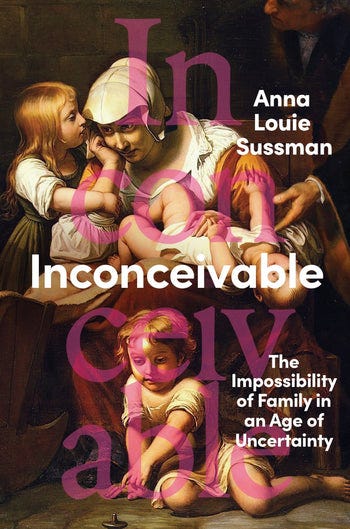
Sussman is a careful, humane reporter, and it shows. She is honest that no single villain explains what she’s found: housing costs, hiring practices, hypercompetitive schooling, and the strange new loneliness of dating all get their due. But for all that patience, Inconceivable keeps arriving at the same place: the obstacle is out there, in the system, and the fix, if there is one, is out there too—better policy and better infrastructure for finding a partner or freezing what time won’t wait for.
A nursing student can’t get his community college credits to transfer, so since his career launches late, he and a future partner might need IVF by the time they’re ready to have a child. Sussman lays the failure entirely at the feet of the transfer system without pausing to wonder whether a student choosing a program without confirming its articulation agreements bears some of that risk himself, and without pausing at all on the last link in the chain. IVF shows up here the way it shows up throughout the book: as a backstop, a plan that exists and therefore solves the problem of delay. But it doesn’t quite. Success rates fall with age, ovarian stimulation carries its own real risks (including OHSS, which can hospitalize and, in rare instances, kill), and no reform of the transfer-credit system changes the biology on the other end.
It is somewhat strange that a book this attentive to structural failure never turns the same attention on the structure of the fertility industry it keeps offering as the safety net underneath everyone else’s story.
The same gap shapes Sussman’s treatment of egg freezing. She is right that many of the women she interviews aren’t choosing to freeze their eggs instead of dating: overwork and unstable hours have left them no time to date at all, which is a real thing worth naming. But her account stops at diagnosis. Sussman argues that since the system stole their time, banking eggs is the sensible, almost neutral, response to that theft.
Egg freezing, however, is not a pause button. It is a drug regimen and a surgical retrieval with real failure rates and real physical risk, and there is no guarantee the eggs will ever become a child. A book this willing to spend a hundred pages on hiring practices and housing costs owes its subjects at least a paragraph on what the procedure it keeps holding out as an answer actually does to the body, and how often it doesn’t work.
The same selective attention shows up in how she handles Diane Tober’s research on egg donors. Sussman cites Tober to explain why American women sell their eggs: to pay for school, or to pay off what school already cost them. She then gestures to Europe as the implicit corrective, assuming that where tuition is free or nearly free, the selling would stop. But Tober’s own research doesn’t support that comparison.
Women in Spain, one of the world’s largest egg markets, sell their eggs in large numbers, too. Tober finds the same financial pressure underneath it: not tuition debt, which barely exists there, but rather the cost of rent, food, and simply staying afloat. Sussman never asks why the selling continues once the specific debt she blames is gone. The honest answer complicates her thesis. The egg market runs on financial precarity in general, and tuition debt is only its most visible, American face. An industry willing to recruit wherever need is greatest will keep finding sellers under whatever economic system it operates.
Even the book’s implicit prescription doesn’t survive contact with its own comparative method. Denmark comes close to a natural experiment for the claim that better social support fixes the birth rate: generous parental leave, subsidized childcare, and universal healthcare—exactly the package Sussman sets against American scarcity. Denmark’s fertility rate has fallen anyway, from about 1.9 children per woman in 2008 to under 1.5 today. The researchers studying that decline point to career pressure and work-life conflict rather than benefit adequacy. If even the most generous system in the developed world can’t hold the line, the American shortfall may not be primarily a policy-design problem either.
There’s a harder question the book doesn’t ask its American subjects: How much of the scarcity is involuntary?
The United States remains one of the most privately generous countries in the world, giving away roughly 2% of GDP, several times the rate of most peer nations. This is not the profile of a people crushed by a heartless system so much as of a people who have chosen to meet want privately rather than hand it to the state. Marvin Olasky made a version of this argument 30 years ago in The Tragedy of American Compassion: when government took over the personal, conditional, relationship-based work that charity used to do, it didn’t just change who wrote the check; it eroded the mobility and mutual obligation that came with real communities helping their own.
Sussman is honest about wanting a Denmark-style safety net for American families; she is less curious about what a welfare state costs a culture’s instinct to build that safety net for itself. That gap compounds later. Graduates who leave school with little or no debt also tend to buy their first home sooner and for more: borrowers carrying over $35,000 in student debt are 27% less likely to buy a home at all, and those who do buy spend nearly 40% less than debt-free buyers when they finally do. The choice made at 22 to avoid debt shows up again a decade later as a down payment. A book this attentive to structural cost should notice when part of the cost is a stack of personal choices.
None of this makes the ache Sussman documents any less real. But it is worth remembering that it is not new. “There is nothing new under the sun,” the Preacher wrote in Ecclesiastes, surveying a world of labor and want and finding no system that ended either. Having children, providing for them, and finding someone to raise them has been hard in every age, for reasons no century has fully solved.
Inconceivable is a book of its age in the way it reaches, almost by reflex, for technological and political answers to a difficulty older than any economy: better maternity leave laws, better dating apps, better assisted reproductive techniques to increase the odds. I don’t share that reflex. Some problems are not, in the end, engineering problems.
But Sussman already knows something better than her own conclusions suggest. Early in the book, before the policy recommendations arrive, she does something harder and rarer: she sits with her subjects long enough that their fear reads as fear, not as a problem waiting on a fix. That patience, not the next law or the next fertility lab, is closer to what the ache asks of us. Agur never promised the barren womb an answer, either. He just told the truth about it, plainly, and let it stand next to Sheol and fire and thirsty ground without flinching. A book willing to do that all the way through, and not just in its reporting, would have been the better book. It would also have been the truer one.
Jennifer Lahl, RN is the founder of the Center for Bioethics and Culture Network. Lahl’s writings have appeared in publications including Cambridge University Press, San Francisco Chronicle, Dallas Morning News, and the American Journal of Bioethics. A frequent media commentator, she has been interviewed by ABC, CBS, PBS, FOX, and NPR, and has spoken before lawmakers, scientific panels, the European Parliament, and the United Nations Commission on the Status of Women.
