



The Country that Disobeyed History
The story is well worn by now. The Cold War presented a choice between two stark visions of government and society: communism and the free world. Communism ultimately failed to deliver, and the USSR fell beneath the weight of its own corruption and economic decrepitude. The American-led order imagined that it had delivered the death knell to communism for good. Liberal democracy appeared triumphant.
The fact that China continued to operate as a communist state seemed to be a mere accident of history that would shortly be resolved through free markets and liberalization. At least, this was the thinking in America and Europe. It was only a matter of time before China, too, made the transition to liberal democracy and free-market capitalism. This comforting narrative has turned out to be false in most respects.
China did not liberalize. Although China opened up for a period, it has since closed down, constructing a surveillance state and social credit system that would be the envy of any dictator. China’s market did become relatively free for a time, but under Xi, the CCP has reasserted its dominance over the market, sometimes crushing companies that have accumulated power and influence, as the case of Jack Ma illustrates.
Engineers vs. Lawyers
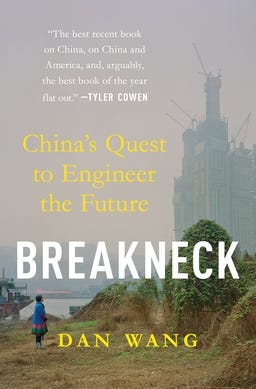
As the rivalry between the United States and China has intensified, shifting from friendly to hostile, the rhetoric and predictions have also reached extreme forms, vacillating between prophecies of American decline and overly confident assertions of China’s imminent collapse. The reality is much less clear, and Dan Wang’s book, Breakneck, provides the kind of sober and realistic analysis that is sorely lacking.
Wang was born in China but moved to Canada as a child. He made his name as a China analyst, developing a reputation as one of the most astute observers of the country. His annual newsletter garnered intense interest as international corporations sought to understand trends and developments in a country whose behavior, especially that of its political rulers, is often opaque and difficult to decipher.
In Breakneck, Wang sets out to take the measure of these two superpowers, laying out what he sees as their strengths and weaknesses. The book focuses more on China, with periodic points of contrast with the United States. The elegant heuristic Wang explores is what he describes as ‘the engineering state’ versus ‘the lawyerly state.’ The Chinese government and society have been dominated by engineers for the past four decades, which helps account for the massive expansion of manufacturing and construction over that period. America is a society run by lawyers who focus on protecting individual rights and processes. Therein lies the conundrum: “China is an engineering state, which can’t stop itself from building, facing off against America’s lawyerly society, which blocks everything it can.”
The differences between these two superpowers are often emphasized, but Wang sees many similarities. Both are driven by “a strain of materialism” that contributes to “a spirit of vigorous competition.” They are pragmatic and energetic. Both countries are filled with hustlers and entrepreneurs and share a deep awe of the “technological sublime.” More than anything, however, they have a deep and abiding “faith that theirs is a uniquely powerful nation that ought to throw its weight around if smaller countries don’t get in line.”
What China has achieved over the last forty years in building and development has been nothing short of astounding. Transforming a country plagued by grinding poverty into an industrial juggernaut is the economic success story of the twenty-first century, mirroring in many respects the American industrial expansion of the early twentieth century. But that America is gone. Although the United States may excel at technological innovation, in the 1970s it shifted toward a culture of blocking and protecting, which is anathema to a culture of building.
The United States creates new technologies, but China possesses the manufacturing expertise to build them at scale. China has assembled communities of engineering practice in places such as Shenzhen and Henan that prioritize the specialized process knowledge required for high-end manufacturing - knowledge that can be acquired only over time. The United States faces a similar problem with high-end chip manufacturing. The exacting process of manufacturing advanced chips at Taiwan Semiconductor Manufacturing Company (TSMC), the global leader in advanced chip fabrication, cannot simply be copied and pasted into another context. It takes years to develop and refine chip-fabrication processes, which require communities of practice to build the skills and knowledge needed to manufacture these extremely complex products successfully.
The California high-speed rail debacle is emblematic of this paradigm shift. Eighteen billion dollars have been spent since 2013, yet not a single section of operational high-speed track has been laid. Mired in red tape and environmental regulations, the project seems destined to become a never-ending black hole of spending with little to show for it.
The Enemy Within
One of the great virtues of Wang’s measured and sensible assessment of these two countries is that it deflates the overheated rhetoric that pits them against one another as mortal enemies. Closer to the truth is that they are their own worst enemies. American and Chinese societies - driven as they are by insatiable and frenetic energy - are more often than not the causes of their own biggest problems.
The way each country dealt with the coronavirus pandemic illuminates this truth. The helter-skelter, patchwork process the United States adopted was enabled by a deep aversion to a top-down, one-size-fits-all policy. Given the bad advice and policy recommendations that came from federal public health agencies, this aversion would seem to be a virtue. And it was, to an extent. But it also produced a chaotic, irrational, and disordered set of rules and regulations that made little coherent sense and were informed more by parochial prejudice than by thoughtful policy.
In the early years of the pandemic, the Chinese government’s rapid and effective response displayed the strengths of the engineering state. Whereas Americans bumbled their way toward a series of half measures, the unified Chinese response appeared to be a model of rational efficiency and lent credence to the Chinese system. Wang lived in China throughout the pandemic and recounts how the early controls were somewhat onerous; given the chaos that reigned in the rest of the world, however, they felt like an acceptable price for relative normality.
Then came the Omicron variant in 2021, with the ‘zero-COVID’ policy on its heels. Major cities such as Shanghai were completely locked down for months, with haphazard planning and little consideration for the suffering the measures would inflict. In the end, the pride the Chinese once felt in their pandemic response melted into desperation and protest against the draconian measures imposed in the fanatical pursuit of a numerical target. It turns out, Wang laments, that the great strengths of the engineering state are also its weaknesses.
The folly of the engineering state is cast in even sharper relief when Wang turns to the one-child policy. The cruel machinery of the state not only imposed unnecessary suffering on the Chinese people for thoroughly unscientific and misguided reasons, but also inflicted on the country a demographic catastrophe that threatens to plunge its economy and society into ruin in the coming decades.
Reckoning
Wang is intent on avoiding the old rhetoric of capitalists versus communists and open versus closed society. That is a weakness of the book, but it also creates space for a different kind of analysis. Instead, he argues that the real success of each country will be judged by whether it improves the lives of its own people. The strengths of the Chinese system are real, Wang insists, and should not be discarded. Improving the material quality of life through jobs, rising wages, better living conditions, and improvements to the built environment is a major advantage of the Chinese state. It has made real, tangible advances in the quality of life for a large portion of its population.
When it comes to answering which country is better positioned for the future, Wang is less sanguine about the engineering state. Its strengths become major weaknesses in the long run. The CCP is fundamentally afraid of its own people. Like a good engineer, it obsesses over control. Rather than unleashing the potential of its people to create a flourishing society, it often stifles and crushes that potential for fear of giving them too much agency.
America’s great strength is China’s great weakness. American society empowers its people, allowing them to develop their skills and talents free from state control. This pluralism supports a more hands-off approach and permits the experimentation and innovation that have become hallmarks of American culture. The real question for America is whether it can recapture the sense of dynamism that has marked Chinese society in recent decades. The American left and right, each in their own way, hamper society and government from undertaking the large, visionary projects that defined early-twentieth-century America. Can America recapture its dynamic spirit, or will it continue to get in its own way?
Sounds like an interesting book. Does he get into how America went from a nation of engineers to a nation of lawyers?