


Reflecting on his combat deployment in a series of Op-eds published some years ago in the New York Times and other publications, a formerly commissioned Marine Lieutenant grappled with his abetting in the killing of two unarmed Afghan kids. It was an accident; but this hardly affects his moral assessment. His patrol had suddenly come under attack, and, following a series of misperceptions amplified by the fog of war, they opened fire on a motorcycle that was advancing threateningly close despite the patrol’s more pacific attempts to compel the bike to stop. The two riders were killed. Moving quickly to the fallen men, it fast became apparent that neither rider carried a weapon—nor that either was older than sixteen.
Looking back, safely removed now in time and space, the Marine is convinced that one cannot be both a good human being and a good military officer. He laments that a part of the tension comes from inadequate training. He observes that, prior to deployment, while his ability to kill was greatly refined—he learnt to do it with a variety of means: pulling a trigger, ordering bomb strikes, and even beating someone to death with a rock—his ethical understanding of killing was not. Before joining the military, he understood killing another human being is, simply, always wrong. The only modification he made after training, commissioning, and deployment was that killing is also sometimes necessary. He remains agnostic regarding how something could be both immoral and required. But he is certain that to properly wage war you must recalibrate your moral compass. “I didn’t return from Afghanistan as the same person,” he concludes; “I’m no longer the ‘good’ person I thought I was.”
We can cavil about everything that must be amiss to allow a Marine officer, despite all his practical and theoretical training, formal education, and upbringing, to be sent downrange encumbered with such moral confusion and so inadequate an ethical framework. But we mustn’t think his understanding is an outlier. The paradoxical view that ‘killing is always wrong, but in war it is necessary’ is commonplace in too many quarters of Western—including Christian—moral thought. You will find it replicated, if in varying locutions, throughout combat memoirs stretching back from before America’s founding up through the present day. It characterizes, too, the views of important philosophers, theologians, and public intellectuals, most notably Reinhold Niebuhr. This last assertion may seem odd as Niebuhr is well known for both his sometimes excoriating critiques of pacifism, particularly in its Christian sub-species, and for his almost single-handed push to get U.S. mainline churches to support American entry into the Second World War. But Niebuhr’s critique of pacifism was never a simple rejection of pacifism itself—only of its efficaciousness in a world in which Christians were called not only to follow Christ in an absolute and uncompromising ethic of love but—and Niebuhr thought this almost a contraction—to be responsible too; including by taking the responsibility to make choices between greater and lesser evils. The result, as I have asserted elsewhere, is that Niebuhr can be accurately described as, in principle, a pacifist, but, in practice, as a pacifist willing to betray his normative principles to justify a necessary kill. Indeed, far from being novel, I submit that the Marine’s paradoxical view of violence fits seamlessly into the deep moral narratives that have long-shaped American ideals.
Like all people, Americans are irredeemably storied creatures. As such, and pushing back against a morally vacuous liberal conception of the self as an atomized individual untethered to prior commitments or traditions, moral philosophers such as Alasdair MacIntyre contend that we cannot—or must not—try to make sense of who we are without recourse to those fundamental tales, shaped by the historical experiences of those who came before us, that we have told ourselves from time out of mind. Whether shared around the primitive campfires of humanity’s youth or, later, around dinner tables, hearths, and other familial gathering spots on the shores of a new continent, stories have passed from generation to generation to shape future ones with the wisdom, aspirations, fears, and ideals of the previous. They both constitute as well as frame our understanding of reality, the things we find significant, and, thereby, they give form to the moral obligations we willingly, or begrudgingly, shoulder.
It’s perhaps peculiar to suggest that even Americans, arguably a preternaturally anti-mythological people eager to be disabused of past allegiances, might still need—knowingly or not—the “coherence and direction in history,” as Richard Slotkin puts it, “that myths give to those who believe in them.” But the seeming exception helps prove the thesis: Americans, too, are a fundamentally narrative people. For much of the last 150 years, the defining myth in America has been the Western and the mythmakers have been those who, as Slotkin contends, “tore violently a nation from the implacable and opulent wilderness.” From the early novels of James Fenimore Cooper, written in the 1820s as the frontier was already beginning to recede, to Owen Wister’s defining stories that took us past the turn of the century, through the earliest films that accompanied the birth of cinema, and up to the television and classic movies that shared box office dominance—or by virtue of sheer volume and cultural presence dominated the box office—from the late 1930s to at least the early 1960s, the Western has best reflected, transmitted, and shaped American ideals. These ideals include rugged and self-reliant individualism, integrity, justice, the defense of the helpless, courage, competence, benevolence, and the sacrifice of the few for the many. Fitting descriptors, one might think, for a people proposing to be a city on a hill. But not everyone is so sanguine.
In numerous important works, including the deeply influential Regeneration Through Violence: The Myth of the American Frontier, Slotkin argues that these founding myths of American culture are specifically rooted not in beneficence but rather the ritualized violence of the encounter between white settlers and Native Americans. Americans, he asserts, have formed and repeatedly renewed their national identity and sense of purpose through acts of violence against a “savage” other. In this view, violence, including racialized violence, isn’t incidental to American mythology, it’s constitutive of it. To be sure, I reject Slotkin’s insistence that the violence essential to the Western myth is necessarily racialized violence. While the “Cowboys vs. Indians” trope is often thought of as the default storyline, if you take any list of the highly acclaimed masterpieces of the Western genre, you’ll find the central conflict most often focuses on tensions between white settlers, outlaws, lawmen, and cattle barons. Slotkin’s assertion won’t be bothered by this. He isn’t arguing that every single Western, or even most, features a literal white-versus-native battle—though he does suggest even white outlaws are just Indian proxies. Rather, he insists that the structure, language, and psychology of the Western genre rely on the idea that society must violently purge an “uncivilized” element to survive—and that this idea was forged in the crucible of historic, racialized frontier warfare. This said, while Slotkin’s over-psychologized racial theories are doubtful, it cannot be argued that violence doesn’t serve a regenerative role in Western films more broadly. It would also be hard to defend an assertion that regenerative violence isn’t essential to American national identity.
But it matters—it is morally relevant—that the focus of the violence depicted in Westerns is precisely centered on the abiding theme of wresting civilization out of a wilderness, whether a literal wilderness or simply a frontier made wild by the absence of the rule of the law and characterized by strong and rapacious men riding roughshod over the innocent and weak. This theme typically pairs with the image of a lone hero riding into the morally disordered world to set things right. This hero is not motivated by racial animus, or even a will to power or lust to dominate. Nor, most often, is the threat he will defend against posed by some ethnic “other,” or, even when it is, the threat is not due to the enemy being “other” per se. Instead, the menace is an embodiment of lawlessness, disordinate vice, and regression. Against this, the Western is preoccupied with what is required to secure the innocent and to transition from anarchy to order.
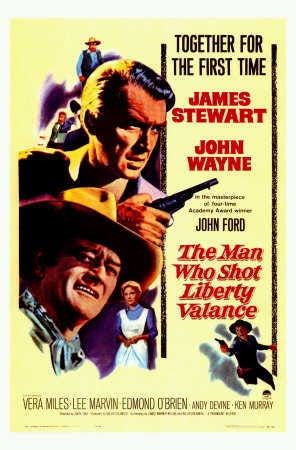
Consider, for instance, John Ford’s The Man Who Shot Liberty Valance. A quick refresher: The film opens with Ransom Stoddard traveling by stagecoach through the wilderness toward the frontier town of Shinbone. The coach is ambushed by the outlaw Liberty Valance and his gang. After robbing the passengers, Valance discovers Stoddard is an attorney intending to set up a legal practice in town. Incensed, Valance tears up the lawbooks, beats Stoddard nearly to death, and leaves him unconscious on the side of the road. Soon, Tom Doniphan, the eponymous hero, comes along, discovers Stoddard, and carries him into Shinbone. He takes Stoddard to an inn, tends his wounds, and pays the innkeeper to nurse him back to health. Sound familiar? The 20th century Protestant ethicist Paul Ramsey wrote significantly about the Good Samaritan as he examined the ethics of the use of force. Whatever impact one might think Christ’s instruction to turn the other cheek has on the right to self-defense, Ramsey observed that few among us would suggest we are supposed to expose the other side of our assaulted neighbor’s face to his attackers’ repeated blows. What then, Ramsey asked, might we suppose the Good Samaritan ought to have done had he arrived on scene while the assailants were still at their fell work? Or if such assaults weren’t isolated and rare occurrences but a routine effect of a larger systemic crisis? Ford’s classic is a meditation on this question. The conflict here is not, pace Slotkin, a racial one. It is a moral one. It is most times incidental whether a Western villain is white or an Indian, but he is certainly a savage; savage in the sense that he represents things that are antithetical to the political goods of order, justice, and peace. Because he does, and not because of what he is, he must be defeated for productive communal life to flourish. The Western, at its best, reveals something genuinely universal that the frontier experience happened to crystallize for Americans—the perennial human problem of how fragile civilized order is and how dependent it is on violent defense. These are themes to be lauded by any healthy political culture.
If we cut a stroke deeper, however, we will see that Westerns are about one thing more, and here we think again of our beleaguered Marine. The Western is also about what civilized order’s dependence on violence costs those who provide it. To get a vision for this tragic undercurrent, consider the broad storyline running through some of the genre’s greatest works, spanning both classical and revisionist Westerns: Shane, Once Upon a Time in the West, The Searchers, Unforgiven, The Shootist and, in more contemporary, neo-western forms, Logan and The Highwaymen. Consider the amplified narrative. Into our morally disordered world in conflict comes the gunslinger, the man of violence. Standing on the side of the innocent against the malevolent forces that would devour them, he destroys the evildoers and brings about the conditions necessary for order, justice, and peace to take root and for the new community to flourish. But having secured this new world, the gunslinger finds he has no place in it. While the cinematography might suggest a romantic riding off into the sunset, the real message seems to be something like: “thank you for your service, now go the hell away.”
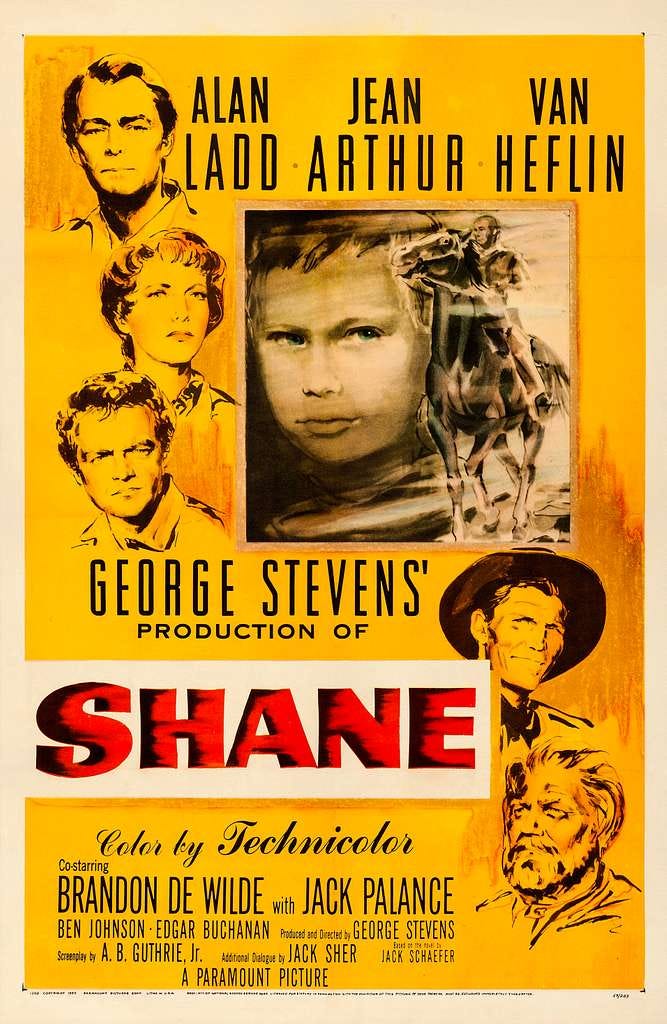
Shane, George Stevens’ 1953 adaptation of an even better book by the same name, is one of the purest expressions of this. Following convention, Shane rolls with the opening credits into a valley of homesteaders under increasing threat by a violent cattle baron who wants them off the land he claims as his own. We don’t know all the details, but it’s clear that Shane has lived a life intimate with violence, and that, however good he was at it, he is now trying to settle into something rather less kinetic, bloody, and ugly. But in the end, when it’s clear nothing else will protect them, the good people of the valley require Shane to be what he is—a man gifted with the capacity for the controlled application of extraordinary violence. Importantly, what follows is not carnage-as-entertainment. Rather than glorified brutality, the violence in Shane, typical of the genre, is morally purposeful, appearing only as a last resort in the proportionate and discriminate defense of rights against those who initiated unjustified aggression. Nevertheless, Shane is a meditation about the price that violence exacts—not just on those who suffer it, but also, and especially, on those who inflict it. “There’s no going back from the killing,” rues Shane, “right or wrong it’s a brand, and the brand sticks.” And so, job done, Shane follows the closing credits up and out of the valley. There is no place for him in the community now at peace.
The Western’s ambiguity regarding violence is an echo of the “killing is wrong but in war it is necessary” sentiment and it signals a tension—even a contradiction—in American thought. It is also a catastrophe. This is because the sentiment is also reflected in the literature on military moral injury. Drawing on early clinical research by Veterans Affairs psychiatrist Jonathan Shay, and later expanded by others, a moral injury is a kind of psychological wound that emerges out of trauma caused by either—or both—“betrayal” or “transgression.” The betrayal involves suffering a profound breach of what was right by someone in a position of authority in a high-stakes situation. The transgression involves witnessing, perpetrating, or failing to prevent acts that violate deeply held moral beliefs and expectations. Of course, these overlap in obvious ways. An act in which you are the transgressor is just another kind of betrayal, except in this case you are yourself the traitor, having let yourself down by discovering that you actually are the lousy sonofabitch you really hoped you weren’t. Regardless of its origin, internal or external, the psychological and spiritual aftermath of a moral injury includes the presence of crippling degrees of guilt, shame, self-loathing, alienation, a loss of trust, purpose, or meaning, and grave remorse.
The problem with all this is more than conceptual. First, the primary predictor of moral injury among military personnel is having killed in combat. Second, the overwhelming evidence from large-scale studies confirms that moral injury is a primary predictor of veteran suicide. In other words, having killed in combat is a chief predictor of veteran suicide. Combat veterans who screen positive for moral injury are approximately six times more likely to attempt suicide in their lifetime compared to those without moral injury. This remains true even when statistically controlling for other severe conditions such as PTSD, depression, or substance abuse.
The “killing is wrong but in war it is necessary” sentiment is even more pronounced when we realize that there is nothing in the clinical literature to suggest that the kind of kill—whether lawful, accidental, or an atrocity—matters. All kills, regardless of the legality or intent of the actor, are statistically significant predictors of elevated psychiatric distress. Too many of our boys and girls who grow into the men and women who fight our wars are being conditioned, intentionally or not, by family, faith, and societal norms to believe that taking a human life is the ultimate transgression. When they cross that line, the result can be immediate cognitive shock that comes at devastating, tragic, and total costs.
A part of the tragedy is that it needn’t be this way. While I stand by my assertion that the American Western is a—if not the—quintessential expression of the American view of violence, there is another, deeper view drawn from our Classical and Hebraic inheritance, that insists that all killing is morally wrong is a philosophical error. Christian theological intelligence, best exemplified on these matters by the tradition of just war casuistry, is grounded in the basic truth, echoed in both common sense and -law, that killing comes in different kinds. One kind of killing, we call it murder, is always wrong—and ought never to be done. Another kind of is basically morally neutral, such as unavoidable accidents. Yet another kind is morally permitted—even, sometimes, obligatory.
This isn’t to downplay the gravity of homicide, it’s only to say that not every kind of killing, pace our Marine, is morally wrong. This is because evil, like killing, also comes in different kinds—at least two: moral and non-moral. Both kinds emerge from an Augustinian account of evil as privation. An evil occurs when a thing is deprived of a good essential to, or proper to, its nature. Take this kind of good from a thing and you haven’t just taken something from it; you’ve diminished what it is. A blind stone hasn’t suffered an evil, for sight isn’t proper to stones. A blind child has, for sight is proper to a child. By this account, British philosopher Nigel Biggar can stress that killing another human being is always to cause an evil, because it deprives the victim of the good of life. He rightly presses this notion all the way down, applying it even to the killing of someone “who has let himself grow monstrously corrupt—think Hitler, Stalin, or Pol Pot.” That their deaths seem to involve the loss of nothing good is only because they have “so misdirected their lives,” that their losing the good of that life amounts, for most of the rest of us, “to a moral gain.” Yet, while to kill a person is always to cause an evil it is not always to do a moral evil. A moral evil is a privation caused by a will that ought to have chosen otherwise. A just warrior—or a just gunslinger—causes a non-moral evil, the genuine privation of the good of life, every time he kills a man. But he is not doing anything morally wrong if he has not knitted his will to depriving a thing of a good proper to its nature without moral justification. Biggar explains it this way: “I can kill you out of contemptuous hatred, intending nothing less than your annihilation, constrained by no necessity, and with no proportionate reason to prefer another’s life to yours. Or I can kill you without malice, with respectful and manifest reluctance, necessitated by love for others, and with sufficient reason to prefer their lives to yours.”
A lot is riding on our ability to make these basic distinctions. A good society’s sons and daughters must be nurtured to grow into the kinds of men and women who can do justice in the right ways, for the right reasons, at the right times, with the right intentions, and against the right things. The moral narratives drawn from the hard men of the West mustn’t be forgotten. Implicit in Ford’s masterwork is the understanding that their memories must be maintained in the stories we tell to steel the spine of those who come after, to fortify their spirits, and to stiffen their resolve. If we forget these lessons, when good men cannot be counted on to stand between the victims and their aggressors, then men like Liberty Valance–his very name signals a perversion of freedom–will rise and rule in their cruelty.
But the Western’s view of the costs of even resisting men like Valance must be amended. It is not wrong that our Marine felt grief over the killing of a pair of Afghan kids who posed no threat. To not feel grief would be a calamity. But not all grief signals real guilt. Guilt—moral injury—must be reserved as the proper response following genuine acts of willful—or culpably irresponsible—wrongdoing. For the sorrow that arises from having done something hard and terrible that was nevertheless morally right or neutral, we should prefer what I call moral bruising. A bruise is an impact trauma. It mirrors more serious wounds in that it hurts, might cause some measure of a loss of function, and may be disfiguring. But with a bruise these things are far more temporary and far less dangerous.
My love of the Western is tempered by this shortcoming. Shane’s “brand” conflates the grief of killing, appropriate and even honoring to the humanity of the person killed, with the guilt of wrongdoing, which is not warranted when the killing was just. The Western’s mythology, on this point, is therapeutically catastrophic. Guilt needs repentance, forgiveness, and penance. Grief needs acknowledgment, mourning, and a community of friends. But this is precisely what Shane won’t find as he returns—or is driven back—into the wilderness. My fear is that American culture too often follows the Western in forcing remedy by aestheticizing us to the “killing is wrong but sometimes necessary” paradox in a way that makes it feel resolved when it isn’t. Shane rides away looking noble and tragic. The sunset is beautiful. The music swells. Caught up in the heroic dimensions of it all, we may feel some measure of closure when the curtain falls. But those who do our nation’s violence must endure long past the credits. We owe it to them to overcome the failures of our public and private institutions—involving not simply the military but academic, ecclesiastical, cultural, social, and family ones as well—to provide the conceptual resources necessary to think accurately about the moral complexities of killing and the duty to bring order and peace out of chaos. But we also owe it to ourselves, so that we are honest about the moral project of maintaining peace and the means that are necessary to achieve those ends.
Marc LiVecche is the McDonald Distinguished Scholar of Ethics, War, and Public Life at Providence: A Journal of Christianity and American Foreign Policy. He is also adjunct professor ethics at the US Naval Academy. He is the author of, The Good Kill: Just War and Moral Injury (OUP 2021, paperback October 2026)
