

The men who shaped the postwar settlement set out to tear down our founding myths and raise new ones in their place. Their cultural revolution was terribly effective. In most of our history, children would read of larger-than-life men who Christianized the New World and cut civilization out of the wilderness. Today, our legends are recast as tyrants, slave drivers, and colonizers. It seems that some still understand the value of heroes—they just hate ours.
If we are to restore the spirit of America, we must begin by rebuilding our founding mythology from first principles, beginning by explaining why these stories matter.
How Virtue Is Formed
Aristotle argues in his Nicomachean Ethics that virtue is built by habitual action. Man is virtuous because he does virtuous things, as the builder becomes better at his craft by building. It is not enough, however, simply to act habitually; one must order his habits properly. The builder could build poorly for 20 years and be no better than the day he began. The quality of one’s actions is judged according to the mean—avoiding both excess and defect in behavior. True courage, for example, is found somewhere between cowardice and recklessness.
Equally important is the manner in which we act. Thomas Aquinas, commenting on the Nicomachean Ethics, states that “after the habit of virtue has been formed, such operations are carried out with delight, because a habit exists as a sort of nature.” Aquinas observes that a virtuous man enjoys the good, and that his habits have become reflexive. Therefore, how one’s habits are formed matters a great deal.
Finally, Aristotle says it is important for a child to be educated early “so as both to delight in and to be pained by the things that we ought,” for in doing so we form good habits from our youth.
As helpful as these definitions are, they are least useful to children—the very ones who need them most. How does a young boy determine the mean of courage with the wolf in front of him? Does he stand and fight, or run for help? These choices aren’t always obvious, and there is no simple rule to rely on. Aristotle answers that the mean is whatever the “man of practical wisdom” would judge it to be. But wisdom takes years to develop, and the wolf is here now. So the boy looks for a man with proven judgment and follows his example.
This raises the question: Who is worthy of emulation?
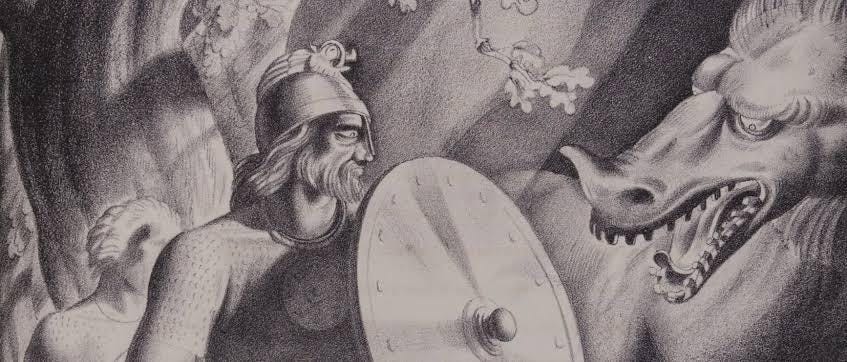
Rockwell Kent’s “Beowulf Fighting the Dragon” (1931)
Mythology as Moral Instruction
The Aristotelian man is most easily found in the stories we tell ourselves. This is most obvious in fiction, where men like Beowulf embody the Anglo-Saxon spirit. But real men are mythologized too, both to honor their memory and to set them before us as examples. We recount tales of great men so that we too can be great.
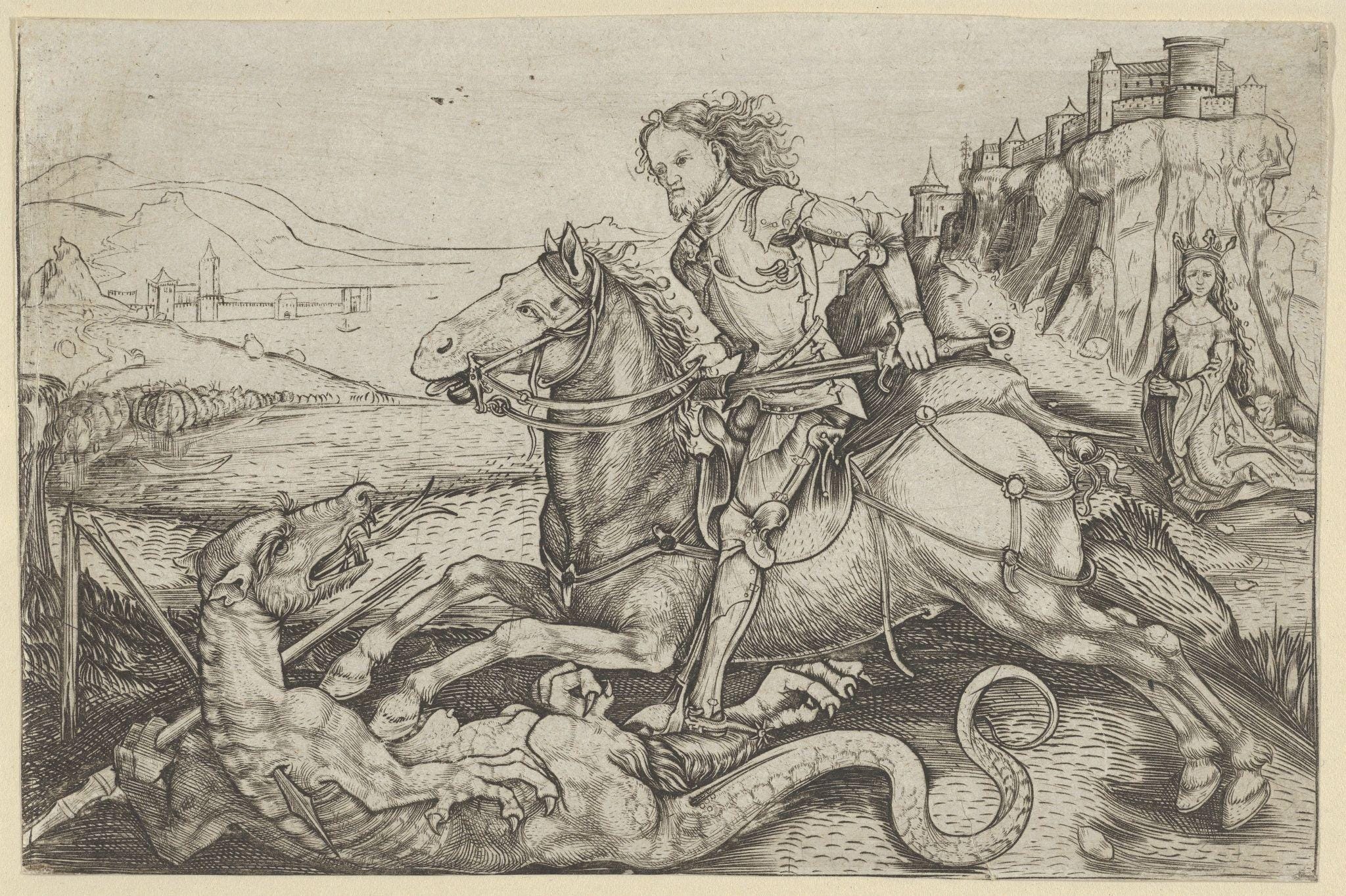
In these stories, knotty philosophy is boiled down until its meaning is made simple, even to a child. Saint George slays the dragon because he is a knight, and knights protect the innocent from evil beings. We understand the dragon as a great evil, but why? For one, it is dangerous—mankind’s foe since Eden, presented here in its most terrible form. Beyond that, it is greed and malice made flesh, for in its cave lies both treasure and the bones of those who sought it. It must be fought because good men do the right thing, even if it is perilous. The message then becomes something like “you are duty-bound to face the terrible evils of this life, so do it, and let God determine the outcome.”
For a young child, this is enough. Having looked into the face of evil (albeit on the page of a book), he now has a model of courage, honor, and duty. What he does not yet realize is that by playing Saint George, he is also reenacting an ancestral story. He is drawing his virtue from the same source his forefathers did, kings to peasants. George’s story is the story of the West itself, in which virtuous men brought pagan chaos under Christian order.
This is what it means to live historically—to receive what your fathers built, to add to it, and to pass it down to your children. These stories are the sinew that binds us to our fathers and will bind our sons to us.
The American Mythos
Our cultural inheritance goes back to pre-Christian Europe. Sallust recounts that Quintus Fabius Maximus and Scipio Africanus said that when they looked upon the wax masks of their ancestors, “their hearts were violently kindled toward virtue.” Their own battles with Hannibal during the Second Punic War would be immortalized.
Famously, our own Founding Fathers saw themselves as modern Romans. Washington was called the “American Cincinnatus” as a reminder that men should be both citizen and soldier, and that virtue can overcome the base desire for power. It was common to see essays signed Brutus or Fabius during the ratification debates. Nathan Hale, facing the gallows, is remembered as saying, “I only regret that I have but one life to lose for my country.” Hale’s words are a direct reference to the 1713 play Cato: A Tragedy, one of the most popular in the American colonies.
Many American legends have waned in the modern age. Surely, some still remember the Alamo, but the stories of Jim Bowie and Davy Crockett are fading. Not long ago, boys would race through the woods armed with cap guns, hunting outlaws like Wyatt Earp. These stories were torn apart by our supposed cultural betters because they were too useful in forming American men.
The Reformed Case for Mythmaking
The West’s oldest stories are pre-Christian, and the church has long argued over what to do with them. As Alcuin famously asked in 797, “What has Ingeld to do with Christ?”
Scripture offers one answer. Writing to Titus, Paul quotes the pagan poet Epimenides in his indictment against the Cretans, “One of the Cretans, a prophet of their own, said, ‘Cretans are always liars, evil beasts, lazy gluttons.’ This testimony is true” (Titus 1:12-13). John Calvin, commenting on the verse, goes further: those who reject heathen authors are superstitious, since “all truth is from God; and consequently, if wicked men have said anything that is true and just, we ought not to reject it; for it has come from God.”
One might object that Paul has no use for myth. He warns Titus against “Jewish myths” in the very next verse, and the word carries negative connotations across the pastoral epistles. But Paul’s concern is myth passed off as doctrine (commandments of men or quarrels over the law), not storytelling.
In Mythopoeia, Tolkien writes that the art of mythmaking is a reflection of God: “We make still by the law in which we’re made.” Man sub-creates because he was first created in God’s image. Tolkien understood the pagan myths as a refraction of God’s light, an incomplete fragment of a true source. Commenting on Beowulf in particular, he addresses an ancient church debate, “Shall we or shall we not consign the heathen ancestors to perdition?”
Tolkien’s answer is that these stories, pagan though they may be, are still imbued with truth. The Christian Beowulf poet honored his pagan forefathers by treasuring the memory of man’s struggles in the dark past—“Man fallen and not yet saved, disgraced but not dethroned.”
Aristotle himself was well regarded by the Reformers. Peter Martyr Vermigli, for instance, lectured on the Ethics at Strasbourg, and those lectures formed the basis of a commentary—the only one on a non-biblical work in his corpus. Vermigli maintained that grace does not destroy nature, but perfects it, and that pagan works, however much truth they contain, are completed only by the Gospel.
To answer Alcuin, Ingeld has this much to do with Christ. There is real virtue in these stories, and it is worth handing them to our children.
Playing the Man
Picture a boy who was raised on stories of brave men—Beowulf in the mere, Saint George battling the dragon, Crockett at the Alamo. He has learned what courage is by hearing stories about his ancestors. Every night he has imagined himself clad in heavy armor, bracing against the blows of a mighty enemy. He has already decided who he is a hundred times over. When the moment comes to face the wolf, he knows how to play the man.
Children will be shaped by the myths they are told. We still have our own stories, three thousand years of them. Whether we tell them is up to us.
Tyler Tittermary is a writer from small-town Pennsylvania whose work unearths once-common views in Reformed political theology. He has written for the Center for Baptist Leadership, American Reformer, and the Standing for Freedom Center.