


On the final day of the Supreme Court’s 2025 Term, the Court delivered a resounding victory for biological reality. In West Virginia v. B.P.J. and Little v. Hecox, the Court allowed West Virginia and Idaho to reserve women’s and girls’ sports for biological females. The majority reached this outcome on two grounds. First, the Court unanimously held that Title IX’s sports regulations authorize separate teams for each sex in competitive and contact sports. Second, the majority held that the state laws complied with the Fourteenth Amendment’s Equal Protection Clause.
In all, the Justices produced five separate opinions. Those opinions debated several nuanced legal questions. Beneath them, however, was a smaller fight with enormous consequences: the words judges used to describe the transgender litigants.
There were three distinct approaches. The majority generally referred to the plaintiff by the initials “B.P.J.” and described the plaintiff as a “biological male who identifies as female.” In contrast, Justice Sotomayor’s dissent used female pronouns. Finally, Justice Thomas stated firmly that “[m]en and boys with gender dysphoria are not women or girls, even if they believe that they are.” Thus, the opinions presented a spectrum of responses to the transgender movement: avoidance, affirmation, and rebuke.
This split poses a fundamental question: How should federal judges address transgender litigants?
The correct answer is Justice Thomas’s approach. Judges should use pronouns corresponding to litigants’ biological sex and reject the semantic games of the transgender movement’s pronoun regime.
This approach is correct for two reasons. First, it upholds the role of judging. Second, it offers resistance to the transgender movement’s hostile takeover of American institutions.
First, the role of a judge is to apply the law impartially to the facts. Inviting warped realities into that analysis defeats this purpose.
This approach aligns with the Founders’ vision for an independent judiciary and the role of a judge. In Federalist No. 78, Hamilton explained that an independent judiciary - wielding “neither force nor will, but merely judgment” - is “requisite to guard the Constitution.” The judge is thus an arbiter of legal truth. Accordingly, a court that makes its language conform to a litigant’s erroneous identity claim abandons that duty.
Courts have sometimes used preferred pronouns as a courtesy. But courtesy is discretionary. Within this realm of discretion, judges must never subordinate their fundamental obligation to truth to personal politeness.
The Fifth Circuit applied this principle in United States v. Varner. There, the court denied a litigant’s request to be addressed with female pronouns. Writing for the majority, Judge Kyle Duncan explained that no federal statute or rule required judges, court personnel, or other litigants to use pronouns matching a litigant’s gender identity. Justice Thomas’s approach is therefore a clear application of an existing principle: Courtesy may guide a judge’s tone, but it cannot dictate the court’s account of reality.
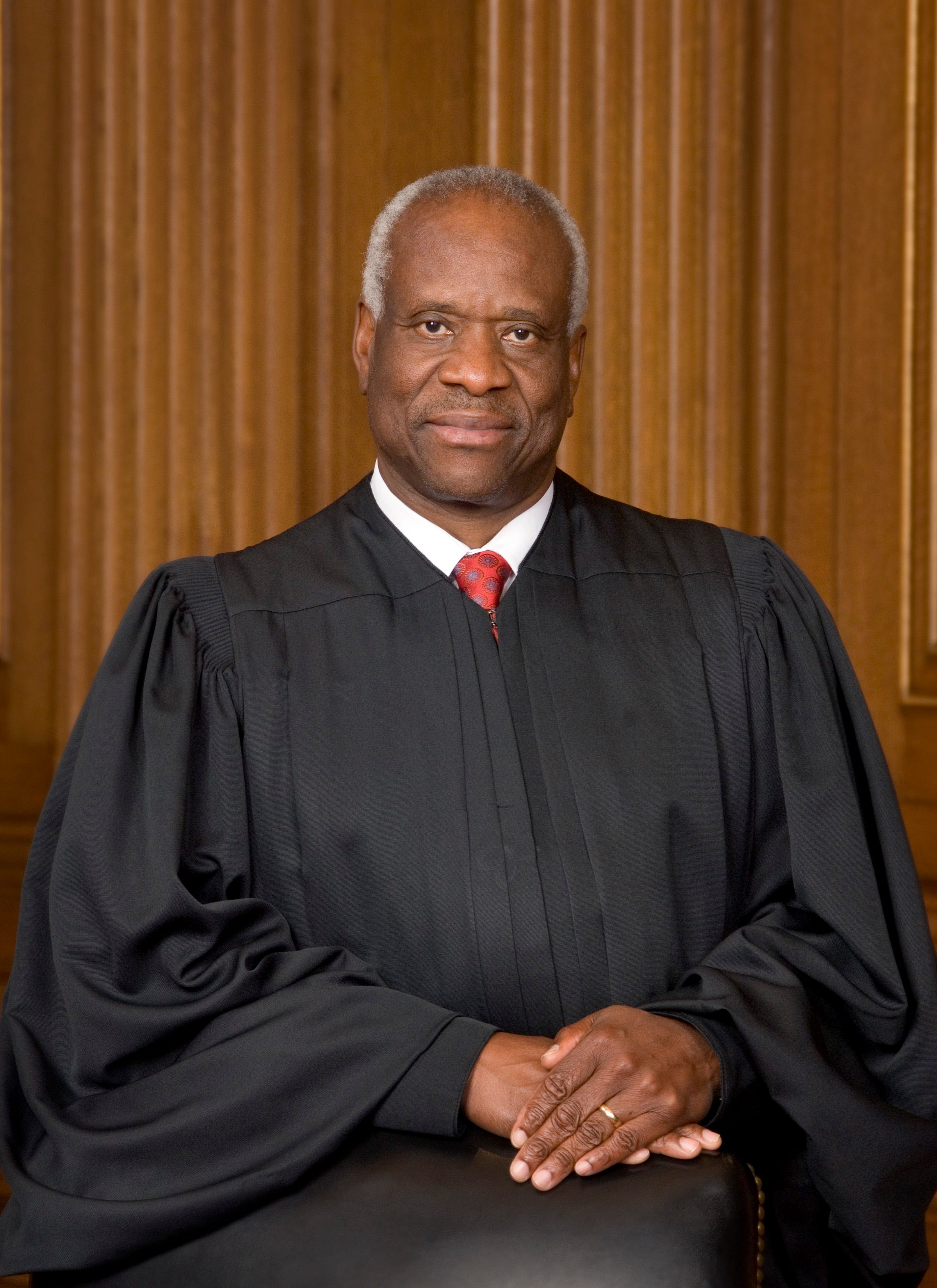
Steve Petteway, Collection of the Supreme Court of the United States, Public domain, via Wikimedia Commons
Second, adopting Justice Thomas’s approach resists the transgender movement’s hostile takeover of American institutions. The Varner example illustrates the judicial front of this campaign, and the examples beyond courts show that it has no limiting principle.
Consider the progression.
The first step begins with the soft language of accommodation. For example, some university pronoun guides list forms such as “ze” and “xem,” along with similar invented pronouns. Each measure seems small, yet each teaches the institution to treat self-declaration as authoritative. Once that premise is accepted, the vocabulary expands.
From there, benign accommodation mutates into enforcement. For example, New York City’s human-rights guidance treats a refusal to use a preferred name or pronoun as evidence of discrimination in employment and public accommodations. The EEOC’s 2024 harassment guidance took a similar path by treating repeated, intentional use of pronouns inconsistent with a person’s gender identity as potential workplace harassment before the agency voted to rescind that guidance. The federal government also tried to write gender identity into Title IX policy: The Department of Education’s 2024 Title IX rule defined sex discrimination to include gender identity before a federal court vacated the rule.
Taken individually, each measure is defended as a small accommodation. Taken together, they amount to a mandate to affirm what is false.
Thus, pronouns become a low-cost, high-reward instrument of power. The claimant announces a preferred pronoun; the institution assumes the work of enforcement; and everyone else bears the cost of dissent.
This is deeply troubling for the future of the country. In today’s polarized society, productive debate is essential. But dialogue cannot occur when language is distorted. Words like “man” and “woman” and “boy” and “girl” assert biological truths. When those words become meaningless, constructive disagreement dissipates because people cannot even agree on foundational premises.
Other judges, like Justice Thomas and Judge Duncan, can stand in the way.
Judges have a duty that ordinary citizens do not share. In a pronoun dispute, a private person might choose evasive language to avoid conflict at work. A court, by contrast, speaks with public authority. Its words settle disputes and create precedent. Thus, if courts cave to the transgender movement, they give the compulsory pronoun regime the prestige of law. If courts refuse, however, they mark a clear boundary that other institutions can replicate.
Accordingly, courts should firmly reject motions that ask judges to call a male “she” or a female “he” in the court’s own voice. Courts should never force litigants or lawyers to repeat words that contradict biological sex.
To be clear, no litigant should be mocked. Indeed, the Court itself said in B.P.J. that litigants should not be “ostracized or vilified.” But respect does not require affirming blatant fantasies. The law can protect people from abuse while refusing to conscript others into a lie.
Courts exist to say what the law is. That duty begins with saying what is true.
Jimmy Murphy is a law student at the University of Notre Dame and a future law clerk on the Fifth Circuit. His conservative commentary has been featured in outlets such as The American Thinker, The American Spectator, The Washington Times, and others.
Oh that the Lord would give us more men like Clarence Thomas, men of intelligence, courage and most particularly moral clarity.