


“I expect I’ll receive public criticism for publishing this book.”
That sentence is from chapter 1 of Loser Theology, page 26. Dr. Brian Tabb has stepped up to the plate with a critical review. I’m glad he did.
Dr. Tabb was kind enough to send me a draft before publication and to invite my feedback, for which I am grateful. I appreciate the review itself, too. He took the time to read the book, summarized it, and commended its call for moral clarity and courage.
Thank you, Dr. Tabb, for your review.
Dr. Tabb is the president of Bethlehem College and Seminary and the general editor of Themelios. The Gospel Coalition brought out the big guns on this one. Good. When a man of Tabb’s position and credentials publishes a critical review of my book, that can only mean one thing: Loser Theology is a book that cannot be ignored.
This is a discussion that’s long overdue. There’s too much at stake.
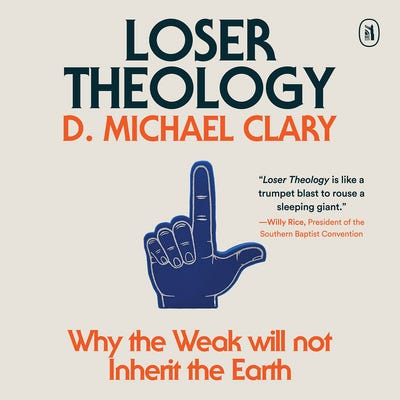
Loser Theology was written to mount a frontal assault on the passivity and weakness in the modern church that have caused so much damage. TGC may be critical of Loser Theology (the book), but it has been a vocal cheerleader for loser theology (the teaching).
Is the title provocative? Well, check out these headlines and decide for yourself.
“Jesus Is for Losers,” TGC, Jared C. Wilson (Feb. 16, 2016)
“All Christians are ‘Losers,’” TGC, Chris Colquitt (Feb. 12, 2021)
Will Sorrell published another article for TGC saying, “Losing is for losers, right?” He goes on to extol the value of losing by saying, “we don’t need to be theologians of glory… we need to be theologians of the cross.”
Over at Christianity Today, they published an article entitled “We Should Be Better Losers.”
So, maybe the title isn’t as provocative as some suggest. Maybe I’m just using the same language these outlets use.
Back to Tabb’s review. He seems to be a thoughtful and reasonable man who engaged my book fairly, despite multiple misreadings at decisive points. Let me explain where.
The central misunderstanding
If a book calls readers to reject something called loser theology, what would you expect the alternative to be? Perhaps “Winner Theology”?
Actually, no.
That’s the central mistake in Tabb’s review. Near the end of the review, he calls my position “Winner Theology.” In the conclusion, he says, “Clary misses the mark by redefining ‘winning’ and ‘losing’ according to conservative American values and optimistic eschatology rather than the priorities of Jesus and the apostles.”
That is not what the book argues.
The alternative to loser theology, the label for the first half of the book, is “High-Agency Christianity,” the label for the second half. I chose these labels on purpose. I avoided building my case around “winning” and “winners” because faithfulness is not measured by outcomes.
Loser theology, as criticized in my book, does measure faithfulness by outcome: “I’m losing, so I must be a faithful Christian.” “Winner Theology” would make the same mistake in the opposite direction.
High-agency Christianity is the active assertion of the Christian faith through good works, whatever comes of it. The book says repeatedly that high-agency Christians may suffer precisely because they assert their faith in the face of opposition. A high-agency Christian may succeed in life or he may lose. Faithfulness is not determined by any particular outcome. It is found in the pursuit.
That said, I do believe winning is preferable to losing. I tell Christians that they should outwork the pagans competing against them. Wanting to win is one thing. Measuring faithfulness by winning is another. The book does only the first.
This should be the least controversial claim in the book. I assume Dr. Tabb wrote his review because he wanted to win the argument. Good for him. I don’t fault him for that. I want to win the argument as well. My position is that Christians should pursue victory, knowing we may suffer defeat and that God is sovereign over which one we get.
Aims too low?
The title of TGC’s review is “‘Loser Theology’ Aims Too Low,” presumably because Tabb believes I’m willing to settle for worldly victories instead of heavenly ones. But that’s false. Tabb’s own definition of true victory answers this charge. He says victory “entails costly faithfulness to Christ and spiritual conquest against sin and evil.”
Yes and amen. I agree. That’s actually the aim of the book. I call Christians to pursue faithfulness in every area of life, even when it is costly. “Whatever you do, do all to the glory of God” (1 Cor. 10:31). That includes the home, the workplace, the church, and the public square.
That’s the problem with loser theology. It limits our pursuit of costly obedience to explicitly religious duties, such as evangelism and missions. But do we not also have a duty to pursue costly obedience in the public square? Should Christians not be called to risk it all to recover cultural ground that we’ve lost?
That’s why I’d say it is loser theology itself, not my book, that aims too low. A theology that keeps Christ’s Lordship inside the walls of the church aims lower than mine.
The same misunderstanding shapes the eight questions Tabb poses about my project. I’ll limit my comments to the ones that bear most on the argument.
Who are the losers?
Tabb observes that the book bundles together several kinds of critique. There’s a critique of passive, lazy Christians; of Christian leaders pushing a leftist agenda, such as Russell Moore; and of a third group of leaders who hold conservative doctrine but use “white flag” rhetoric in their books and sermons.
He’s right about that. I did it intentionally. Calling out various leaders isn’t “petty name-calling” (p. 25). The difficulty of a project like this is labeling something many Christians feel intuitively even though the error isn’t expressed in a clear doctrinal statement. Loser theology exists more as a vibe than a formal system. It’s a moral impulse people feel even though it may not make sense to them.
For example, some people feel that a pastor shouldn’t speak out about politics, though they have no developed political theology. Why do they feel it’s wrong when they can’t give a biblical rationale for it? Because they’ve learned that Christians “should be better losers” from various voices in the evangelical ecosystem.
Loser theology doesn’t have a single source, a doctrinal statement with affirmations and denials, or an obvious, traceable history. It would be easier to identify and refute if it did. This is also why the men I criticize do not belong in one category. I am blunt with Russell Moore and David Platt because I think the criticism is well deserved.
And then there’s John Piper. Piper is the founder and chancellor of the school Dr. Tabb leads, so I understand why this part of the book drew Tabb’s attention.
What Tabb seems to have overlooked is that I do not put Piper in the same category as the others. Though I have never met him, I’ve long considered Piper something of a spiritual father. I’ve read many of his books, some of them twice. I’m grateful for all I learned from him. Despite our disagreements, I regard Piper as a faithful man of God.
Nevertheless, I have written critically about how his teaching gets misused by those who take it too far. On page 75, I wrote, “Ordinary readers, steeped in Piper’s books, articles, and sermons, might draw logical conclusions from his teaching even he may not personally endorse.” Tabb calls my argument here “imprecise.” After almost two decades of pastoral ministry, I can confidently report that Christians can be notoriously imprecise! I’m citing pastoral evidence that isn’t so easily footnoted. I’ve sat across the table from people who had read Don’t Waste Your Life and felt guilty that they weren’t suffering enough for Jesus.
This is also my answer to Tabb’s sharpest line in the review. He quotes Piper’s statement that “the call of Christ is a call to live a life of sacrifice and loss and suffering.” Tabb speaks as though I’d object to that statement, but I don’t. I agree that Piper is careful to qualify his teaching on suffering in Desiring God. Yet Tabb still calls my account “sloppy scholarship.”
My main issue is the way people have applied Piper’s teaching. His rhetoric is so powerful that they took it too far. I’ve counseled people who absorbed Piper’s emphasis and missed the qualifications.
Many Christians have adopted a kind of “walking-on-eggshells” religion, afraid that any act of courage or boldness might be motivated by pride or selfish ambition. So they do nothing at all, using “an abundance of caution” as a fig leaf for cowardice. They hide their light under a bushel because they fear that letting it shine might be prideful.
Imagine Peter, on the day of Pentecost, hesitating to preach to the crowd because he worried about a prideful motive in his heart.
Tabb says my “animating concern is not commending everyday means of grace but casting a vision for ‘recovering cultural ground, rebuilding institutional courage, and training a generation to engage the world with confidence.’”
First, that’s a false dichotomy. The book assumes the ordinary means of grace. It was written for Christians who sit under preaching, come to the Lord’s Table, and pray, and who then need to know what to do with the strength they receive there.
Second, notice how recovering cultural ground has been set against the means of grace, as though the two were enemies. That is the sort of thing I wrote the book to address. If ordinary Christians hear that, what will they conclude? That faithfulness requires them to stay out of cultural battles.
Ordinary faithfulness is a major theme of the book. In chapter 8, I provide a list of twelve disciplines Christians can pursue. Number six is “Honor the Ordinary,” under which I wrote, “the Christian life is lived in bodies, homes, routines, and commitments, not a vague spiritual fog. Christ has staked his claim over every square inch of the universe, including diapers, deadlines, budgets, chores, study, and work. The man who masters the ordinary becomes useful in the extraordinary” (pp. 248-249).
In what arena do we strive?
Tabb says the “nub of the issue” is that I urge Christians to set their sights on winning in politics and culture. He contrasts my view with the example of the martyrs Polycarp and Perpetua, who died for their faith in the Roman arena.
Polycarp and Perpetua do not refute my point; they make it. They were not executed for being passive and inconsequential. They were martyred because they stood publicly on their Christian convictions and would not back down, whatever it cost. That is exactly the kind of high-agency Christianity I am commending.
By the world’s standards, they lost, and they lost because they were bold. In chapter 7, “Hall of Courage,” I give example after example of high-agency men and women who were bold for Christ. Some lost and some succeeded, but the metric of faithfulness is their obedience, not the outcome.
What power should we seek?
Tabb charges me with equivocation, saying I speak of the power of the Holy Spirit in the same way I speak of power within an institution. I can see how he might conclude that. My intent was to establish a principle about power and then apply it more broadly.
The principle is this: power cannot be an inherently corrupting influence, because God himself gives power to all Christians by the Holy Spirit. Power can be used wickedly or righteously, depending on the character of the man who wields it, a point I make in the book (pp. 180ff.).
There’s a Latin maxim, abusus non tollit usum. In English, that means “misuse does not negate proper use.” The misuse of power does not negate the proper use of power. Tabb cites Jonathan Leeman on the related matter of authority: “Authority is a good and dangerous gift.” So there it is. Authority can be good, and it can be dangerous. I agree.
Now consider this: what has been the prominent messaging from evangelical leaders about authority and power in recent years? From what I’ve seen, it has been almost entirely negative, with scant defense of their positive uses. In the last generation, I’m not aware of any major evangelical leader calling Christians to the righteous pursuit of power. Can you think of any?
So I wrote Loser Theology to make a positive case that Christians can do great and godly things if they pursue power righteously. This doctrine has been greatly neglected. The best antidote to the rampant abuse of power in our society is not for Christians to avoid power but to pursue it, acquire it, and wield it righteously for the glory of God. Running from power to escape its temptations is like a man abandoning his family to avoid abusing them. It leaves all the power to men who feel no such scruple.
What ambition should we rescue?
Tabb worries that “the ambition of ‘High-Agency Christianity’ aligns more with the ideals of this world than with the countercultural values of the kingdom of God.” He notes that I don’t discuss the New Testament’s warnings against selfish ambition (Phil. 2:3).
I address this repeatedly, under different labels. The book speaks of “righteous power” more than a dozen times. It also discusses “Spirit-filled agency” and taking “Spirit-filled risks.” The qualifiers carry the argument. Power must be “righteous.” Risks must be “Spirit-filled.” Selfish ambition is the pursuit of power, influence, or authority for selfish ends. The book opposes it by insisting that these pursuits must always be godly.
This is the point Paul makes in 1 Tim. 3:1 regarding the qualifications for eldership: “If anyone aspires to the office of overseer, he desires a noble task.” What’s he saying? First, the office of overseer is an office of great authority. Second, the man who desires it desires a “noble task.” That desire is to be encouraged. Third, the man who seeks it must do so righteously, which is why this text is followed by the list of biblical qualifications for office.
What future hope fuels our mission?
Tabb assumes that I am “at least sympathetic to a version of postmillennialism.”
I knew someone would raise this objection. I’ve been waiting for it.
My publisher, Canon Press, is associated with Doug Wilson’s Moscow, Idaho, project, and Wilson is a thoroughgoing postmillennialist. I also cite the late David Chilton with approval, and he was postmillennial too.
However, I deliberately avoided making an eschatological argument, other than to observe that the loser mindset thrives under a pessimistic eschatology. And I published with Canon because I knew they would be friendly to my argument (even though I’m Southern Baptist!).
But my argument itself rests on the straightforward commands of Scripture. If I’d argued from an eschatological system, it would have been dismissed too quickly by anyone who isn’t already postmillennial. The call to work hard, take responsibility, act with courage and boldness, and assert the Lordship of Christ over all of life is not the exclusive property of postmillennialists. These commands bind a Christian, whatever his millennial view.
As it happens, I’m not yet convinced of postmillennialism, though I’m open to it. That said, many of my closest friends are postmil. I consider myself more of an optimistic amillennialist.
What is true victory?
Tabb closes his review with a study of what “conquering” means in the book of Revelation: the saints conquered the ancient serpent “by the blood of the Lamb and by the word of their testimony, for they loved not their lives even unto death” (Rev. 12:11).
It’s strange to read things I agree with presented as a rebuttal of my view. Loser Theology is about being strong and courageous, not giving up when it is hard, and asserting the supremacy of Christ over all of life. And if, in that endeavor, we are defeated, may we go down swinging.
Charlie Kirk is one of the central examples of high-agency Christianity in the book. He was not murdered for being a loser for Jesus. He was murdered because he was asserting the Lordship of Christ over all of life. He knew what he was up against, and he chose to stand tall against it, even though it cost him everything. He has received his reward.
Conclusion
I suspect my title did some of the work here. A book called Loser Theology sounds like it must be selling Winner Theology instead. Anyone who picks up the book expecting Winner Theology will likely read with that bias. I’d ask Tabb’s readers to check for themselves.
Dr. Tabb and I agree on more than his review suggests. He says he wants courageous men in his home, his church, and his seminary. He lists my twelve disciplines and grants that many will agree with them, “even some whom Clary accuses of promoting loser theology.” I’ll take that.
We differ on whether the book teaches that faithfulness to Christ requires winning. It doesn’t, and I don’t argue that. I am grateful for his engagement, and I’d encourage his readers to read the book and judge for themselves.
D. Michael Clary serves as pastor of Christ the King Church (SBC) in Fort Thomas, Kentucky (just outside of Cincinnati, Ohio). He has published writings for American Reformer, The Blaze, Christ Over All, Center for Baptist Leadership, The Federalist, Founders Ministries, King’s Domain, Sola Ecclesia, and Truth Script, along with regular writing on his own website at dmichaelclary.com. Michael is the author of two books, God’s Good Design: A Biblical, Theological, and Practical Guide to Human Sexuality (Reformation Zion, 2023), and Loser Theology: Why the Weak Will Not Inherit the Earth (Canon Press, 2026). He is a co-author of the forthcoming Nine Questions About Women's Ministry in the Church (Founders Press, 2027).
