


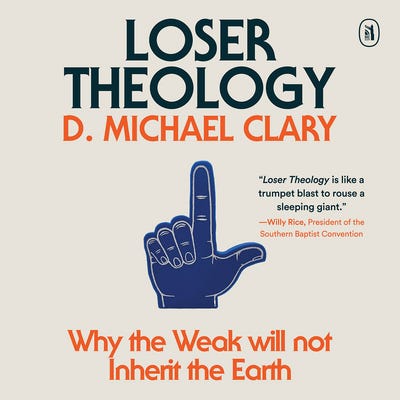
One of the strangest features of contemporary evangelicalism is our ability to reinterpret our own marginalization as a mark of success. If I were Satan (admittedly a funny way to start a sentence), I would have a vested interest in convincing the church that her defeat was a sign of faithfulness—no need to persuade Christians to abandon the faith, only that trying too hard to succeed was spiritually dangerous. That is the problem D. Michael Clary takes up in Loser Theology: Why the Weak Will Not Inherit the Earth (Canon Press, 2026).
“Loser Theology,” Clary writes, is any “theology that advocates for losing as the way to be faithful to God.” More broadly, “Loser Theology can refer to theological perspectives and movements that emphasize passivity, retreat, and defeat, often conflating suffering and loss with humility” (25). The title is provocative, but winning is not, strictly speaking, Clary’s deepest concern. Underneath it lies a concern for agency—active, optimistic striving while recognizing that God alone controls outcomes.
By conflating mundane faithfulness with mediocrity, Loser Theology detaches the cross from the crown. The Christian life is, of course, cruciform. But Christ did not remain in the tomb: humiliation leads to exaltation, and Christian hope includes resurrection, dominion, reward, and final triumph over every enemy. A theology that knows how to lose but grows suspicious of winning has let one set of biblical truths swallow another. Clary’s argument is not that faithfulness guarantees victory, but that the possibility of defeat is no excuse for refusing to strive. Near the end, he puts it succinctly: “We’re not fighting for Christ’s victory; we’re fighting from it” (270). And a page later: “The winning or losing happens out on the field” (271).
Piety Turned Inward
The book unfolds in two movements—diagnosis, then an alternative Clary calls “Rugged Christianity”—moving from defining and diagnosing Loser Theology to discussions of righteous power, courage, positive obedience, and finally twelve practical disciplines. It could almost have been titled High-Agency Christianity.
One of the book’s most useful diagnoses is “Spectator Spirituality”: the assumption that true spirituality always turns inward, so that maturity consists almost entirely in personal piety. Prayer, Bible reading, and self-examination occupy the foreground; building a business, governing well, or raising competent children occupies another category.
Clary describes Spectator Spirituality as creating “a significant blind spot, a kind of ‘deliberate inaction zone’ where outward engagement with the world is either discouraged or dismissed as worldly” (33). The problem is not piety but reducing spirituality to the interior realm—an approach that, Clary argues, “fails to recognize that ‘spiritual’ does not mean ‘non-physical’” (34).
Beneath this lies the old question of nature and grace. Clary invokes the classical principle that grace does not destroy nature but restores and perfects it (49). Hyper-pietism, though, treats grace as if it rendered nature spiritually irrelevant: conversion turns the Christian inward rather than releasing him for mission, and the things embodied creatures naturally do—build, marry, raise children, govern, defend communities—feel like lower-tier activities, since the truly “spiritual” life is assumed to happen elsewhere.
The result is an odd inconsistency. Evangelicals applaud high agency in business, fitness, or investing as faithful stewardship. But let the same instinct enter explicitly Christian public life—bold witness to God’s law, building Christian institutions, seeking authority to protect and promote the good—and different rules apply: the Christian is warned that he is being political, power-hungry, triumphalist, divisive, or insufficiently humble.
Why We Learned to Lose
To the book’s credit, the diagnosis is broader than any one school or movement. Critiques of hyper-pietism, therapeutic Christianity, winsomeness, third-wayism, cultural retreat, and institutional accommodation are nothing new. What is fresh is the framework that gathers these impulses together. The problem isn’t confined to one eschatology or political theology; it fits no older Christ-and-culture category, and it doesn’t depend on villainizing recognizable personalities. Clary is identifying a mindset beneath those debates.
He says Loser Theology can operate “at the precognitive level,” shaping “people’s reflexes and presumptions before they ever opened their Bibles” (27). Or, more plainly: “Loser Theology doesn’t just occupy your theology; it occupies your instincts” (28).
Christians arrive there by different paths: fear of repeating the Religious Right’s excesses or fundamentalism’s mistakes; a reaction against abuses of power that ends up treating power itself as suspect; a desire for mainstream respectability; overcorrection against triumphalism or prosperity theology. Some rightly emphasize humility and suffering but apply those doctrines as though weakness itself were spiritually superior.
But every one of these paths ends in the same place, with Christians hesitant to act.
Any church leader who has counseled timid congregants knows the individual version: I can’t. That would never work. The expectation of failure becomes the justification for never acting. More important is the institutional version. Churches think themselves into the same corners: We cannot attempt [x]; it is too political. We will probably lose. Influence might corrupt us. We should not measure success too carefully; the fruit belongs to God.
Each sounds pious enough; together they amount to an applied theology of paralysis. Clary recognizes the danger: “Some believers are passive because they’re lazy, some because they’re wounded, and some because they’ve been taught weakness is godly. Loser Theology gives each of them a pious excuse to stay that way” (25).
Positive Obedience
This gives rise to one of the book’s most memorable distinctions: between mortification and vivification. Many Christians have a developed account of negative obedience—the “thou shalt not” commandments—but the Christian life requires vivification as well: positive obedience, doing what is good and right rather than merely refraining from evil.
If righteousness consists principally in the sins we avoid, passivity can easily masquerade as obedience. One can avoid many obvious sins while never building, leading, risking, or accomplishing much for neighbor or God.
The application reaches far beyond the political: a mother cultivating a household; a businessman creating jobs; a pastor forming a courageous congregation of households marked by integrity rather than merely avoiding error; a church attempting something difficult enough that genuine failure is possible.
Reclaiming this vision means attempting audacious undertakings that could fail. Visible success is not the measure of faithfulness, but when failure is impossible because success has never been defined, programs continue and everyone stays busy, yet nobody can say whether the institution is accomplishing its purpose. And if there is no conceivable way to determine whether an undertaking has failed, then we never concretely defined what we were trying to accomplish in the first place.
Clary also harmonizes human agency with divine sovereignty. Providence does not exclude creaturely agency; rather, “the agency of man is a secondary cause under a primary cause, God’s providence.” God ordinarily works through means, “and the agency of man is one among many means God uses to accomplish his purpose” (193). Christians should be wary of using theology to cope with a lack of effort.
A Needed Corrective
Clary writes for ordinary Christians—polemically at points, but never as mere diatribe. A restrained pastoral voice runs throughout: he wants Christians courageous enough to risk defeat, not swaggering ones who cannot endure it.
Because the book leans so hard toward courage and agency, it should be read alongside fuller treatments of how God sanctifies his people through involuntary weakness and loss. Christians still need a robust theology of suffering and the cross, but those truths must not crowd out the equally biblical categories of courage, fruitful labor, authority, reward, and victory.
Pastors especially should note the assumptions they communicate in preaching. Do our sermons principally teach which sins to avoid? Do we unconsciously baptize mediocrity? Are we forming Christians who expect to build, risk, and lead—or have we communicated, even unintentionally, that a quiet interior life is the measure of mature spirituality?
His alternative, high-agency Christianity, means taking responsibility and acting through ordinary means. “Responsibility is the engine of agency,” he writes. “Don’t wait to be told. Don’t wait for ideal conditions. Don’t hand your future to circumstances or other people’s expectations. Own your duties. Own your failures. Own your mission” (247).
At a cultural level, that is urgently needed. Christians have lost tremendous ground, and the consequences are not abstract: Obergefell redefined marriage in American law, and even after Roe‘s overturning, the pro-life movement has struggled to secure durable victories protecting the unborn. Christians should be skeptical of any instinct that turns such losses into victories simply because losing can be redescribed as faithfulness.
Yet Loser Theology is ultimately pastoral, and the issue runs well past how Christians vote. The same assumptions about power, risk, suffering, and success confront the businessman, the pastor, the mother at home, and the student.
Closer to home, we should not reach for theology to explain away what fear, complacency, or lack of effort kept us from attempting. We should pray, trust providence, and endure suffering when God sends it—but none of that relieves us of the responsibility to act and to build things worth building, even at the risk of loss.
Clary captures the distinction well: “Loser Theology uses grace as an excuse, but rugged Christianity uses grace as fuel” (272). We must “take courage, act boldly, build faithfully, suffer patiently, fail gloriously, and win humbly, all to the glory of God” (272).
There is room in that sentence for suffering and success, losing and winning. Clary admirably calls Christians back onto the field, where we may win or lose, but where faithfulness requires us first to show up and strive. Loser Theology belongs on your 2026 shelf—to help you navigate a fraught battlefield, and perhaps even win.
Alex Kocman is a Christian, husband, father of five, writer, podcaster, church leader, and missions advocate addressing biblical and cultural issues.
